Good auto repair shop marketing in 2026 is mostly local search done right. When someone types brake repair near me or check engine light Tulsa, they need help today, and roughly three-quarters of local searches turn into a visit within a day. That’s why working with auto repair SEO & digital marketing experts can give your shop a competitive edge. The shops that get those calls have a filled-out Google Business Profile, a separate page for each service they offer, a steady stream of fresh reviews, and a phone that gets answered. You do not need a huge budget to beat the national chain down the road. You need to be the shop Google trusts most for your neighborhood, and that comes down to consistent, specific, local signals.
Why Auto Repair Shop Marketing Starts On Google
Nearly half of all Google searches have local intent, and car trouble is about as local as it gets. A driver with a grinding brake or a dead battery is not researching for next month. They want a shop near them, now, and most of them will visit one within twenty-four hours. A good share of those searches end in a paid job.
That urgency is the opportunity. The driver is not comparing forty shops. They glance at the map, look at the top three results, check the star ratings, and call one. Auto repair shop marketing is really about being one of those three for searches that happen a few miles from your bays. Everything below serves that one goal.
Your Google Business Profile Is The Whole Ballgame
If you fix one thing this month, fix your Google Business Profile. It controls whether you show in the map pack, and shops with a complete profile pull far more clicks than half-filled ones. Yet most shops set it up once and forget it.
Complete means more than a name and address. Pick the right primary category, then add every service category that fits: brake service, transmission repair, oil change, auto air conditioning, engine diagnostics. Add real photos of your bays, your team, and finished work, not stock images. Keep your hours current, especially around holidays. Write a description that names your city and the makes you specialize in.
Post to the profile regularly, just as you would on social. A weekly update about a service special or a common seasonal problem tells Google the shop is active, and active profiles rank better. This steady upkeep is the core of local SEO in Tulsa, and it is the highest return hour you will spend all week.
Give Every Service Its Own Page
Here is a mistake almost every shop makes: one services page that lists twenty things in a paragraph. Google cannot rank that for anything specific, and neither the driver searching transmission repair nor the one searching AC recharge feels spoken to.
Break it apart. Brakes get a page. Diagnostics get a page. AC service, oil changes, timing belts, state inspections- each gets its own page that explains the problem, what you check, roughly what the process looks like, and why your shop is a safe choice. This is where real auto repair shop marketing separates from a business card website. Each page answers one worried question, and each one gives Google a clear reason to send you that exact search.
These pages also feed the AI answers that now sit above the old blue links. When a driver asks an assistant why their car shakes when braking, the shops with a clear brake page get named. Clean, specific content plus answer engine optimization is how you show up in both places at once.
Reviews Are The Tie Breaker
Two shops appear side by side in the map. One has 4.7 stars from two hundred reviews; the other has 4.2 from thirty. The driver calls the first one almost every time. Reviews are the single strongest tie-breaker in local search, and they feed rankings as well as trust.
The trick is steadiness. A shop that earns ten to fifteen honest reviews a month looks healthier to Google than one that got a hundred in a single week two years ago. Build a simple habit: every happy customer gets a text with a direct review link before they leave the lot. Make it easy, and most will do it.
Reply to every review, good or rough. A calm, specific reply to a complaint shows the next reader how you handle problems, and that reply is often read more closely than the complaint itself. Ignored reviews read as an ignored business.
Auto Repair Shop Marketing That Beats The National Chains
Independent shops have a real edge in local search, and most do not use it. Google’s local pack leans on proximity and relevance, not on which brand has the biggest ad budget. A well-kept independent shop in Owasso or Broken Arrow will regularly outrank a national chain’s branch for searches right around it.
To press that edge, be specific about where you are and who you serve. Name your neighborhoods. Mention the routes and areas your customers drive in from. Talk about the problems local cars actually have, as AC systems worked hard through an Oklahoma August or batteries drained by a January cold snap. That kind of ground-level detail is something a national template site cannot match, and both Google and real readers reward it.
The chain competes on brand recognition and a national ad budget. You compete on being obviously, specifically the neighborhood shop that fixes cars like the ones your neighbors drive. That is a fight you can win on your own street, every single day.
Near Me Searches And The Drive Time Radius
Nobody drives across Tulsa for an oil change. Auto repair is a drive time business, and the map pack knows it. Your realistic reach is the ring of neighborhoods within a short drive of your bays, and your whole plan should aim at owning that ring rather than the entire metro.
That means the signals have to line up for your actual location. A consistent business name, address, and phone across Google, your site, and the major directories tells the search engines exactly where you sit, so they show you for the near me searches that happen close by. When those details conflict across the web, the map gets confused and your ranking slips. Tightening them up is unglamorous, and it works.
If you have more than one location, each one needs its own profile and its own page. One shared page for two shops splits the signal and weakens both. Think of it this way: the search engine is trying to answer which shop is closest and most trusted for this driver, right now. Every consistent detail you give it makes that answer easier, and an easy answer is the one that puts your shop in the top three.
Turn The Website Into A Booking Machine
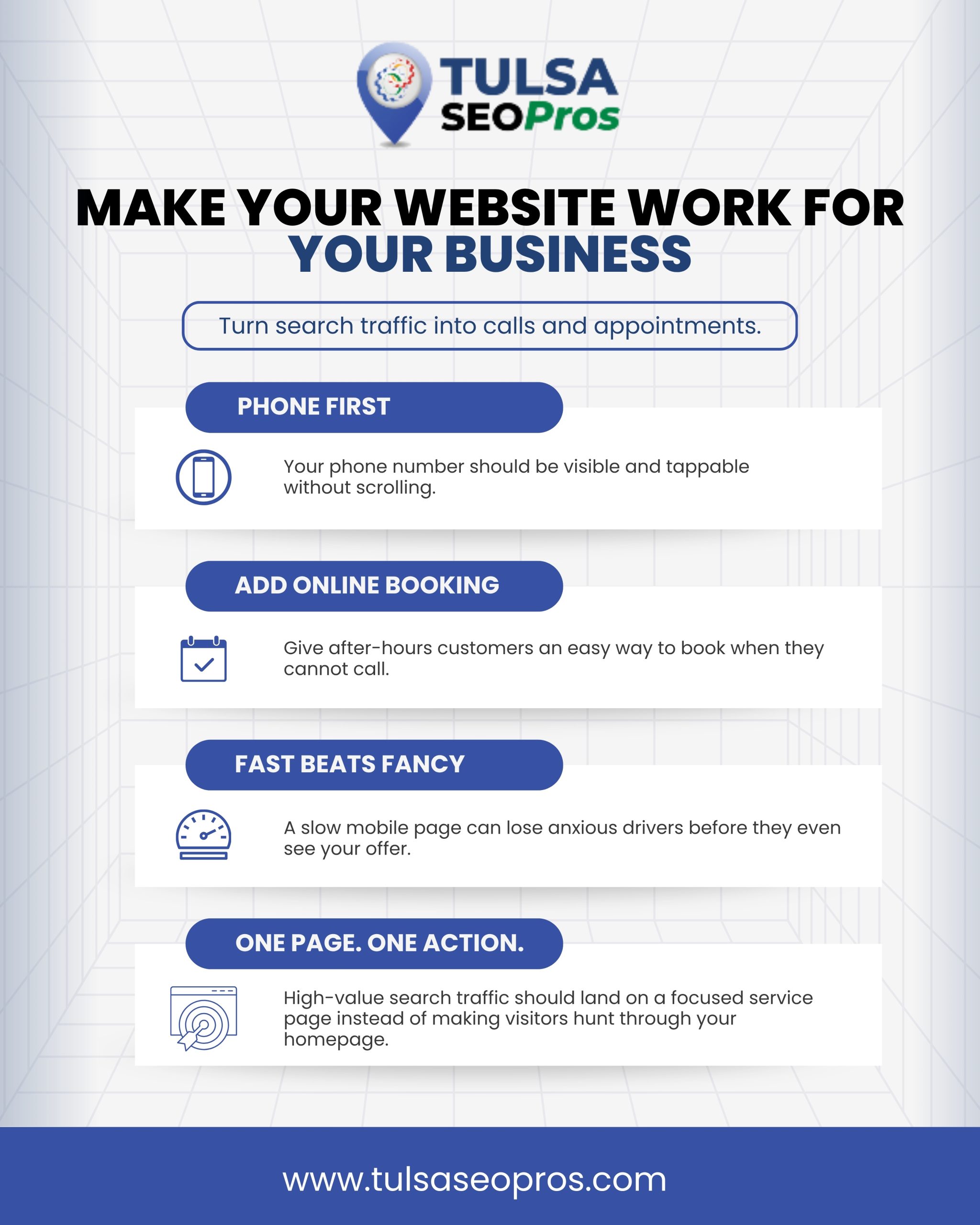
Traffic that does not convert is just a bill. Once search sends a driver to your site, the site has one job: make it dead simple to call or book. On a phone, the number should be tappable and visible without scrolling. An online booking option catches the after-hours crowd who cannot call at nine at night but will happily book a Saturday slot.
Speed matters more than looks. A page that takes five seconds to load on a phone loses a chunk of anxious drivers before they see it. A custom website development page is a fast page with a short form and an obvious next step, aimed at someone who needs help today. If you also run search ads for high-value jobs, point them at these focused pages rather than the homepage, which is where PPC Services earns its keep.
Answer The Phone, Or The Next Shop Will
A driver with a dead car is not patient. If the call goes to voicemail, they hang up and dial the next shop on the map, and you never even knew you lost the job. Missed calls are the quietest leak in most shops, because nothing shows up in a report to tell you the customer came and went.
Put a real person on the phone during business hours. For the calls you cannot catch, a simple text-back tool turns a missed call into a text conversation instead of a lost customer. The same rule covers web leads and booking requests. A reply in ten minutes keeps you in the running. A reply tomorrow reaches someone whose car is already fixed somewhere else. Speed costs nothing, and it beats a bigger ad budget more often than shop owners expect.
Seasonal Content Brings Cars In On Schedule
Car problems follow the calendar, and your content should too. Oklahoma summers punish air conditioning systems, so an AC service page and a few Google posts land right when drivers start searching in June. Winter kills weak batteries, so no-start and battery content earns its keep in January. Spring brings inspections and road trip prep.
Line your service pages, your Google posts, and any customer email up with what tends to break in each season. You end up meeting the driver at the exact moment the problem shows up, which is far easier than trying to create demand out of nothing. Planning a season is simple, and it keeps the bays busier through the slow stretches instead of leaving you to hope walk-ins carry the month.
Track The Calls, Not Just The Clicks
Most shops cannot say which part of their marketing actually brings in cars, so they cut the wrong thing when money gets tight. Fix that with call tracking on your main number and simple conversion tracking on your booking form. Within a few weeks, you can see which searches, pages, and ads produced paying jobs.
Then feed what works. Move budget toward the services and neighborhoods that convert, and stop paying for the ones that do not. A shop that watches its cost per booked job gets sharper every month, while the shop guessing from gut feel keeps repeating expensive habits. You do not need a fancy dashboard; you need to know what a new customer costs you and where they came from.
What To Spend On Auto Repair Shop Marketing
Industry benchmarks put a healthy marketing budget for a shop at roughly five to ten percent of revenue, weighted toward digital channels. The exact percentage matters less than where the money goes. A shop with a thin Google Business Profile and no real service pages should not buy ads yet, because paid clicks would land on a site that cannot turn them into booked jobs.
Fix the foundation first. The profile, the reviews, the service pages, and a fast site are mostly time and effort rather than big spend, and they keep paying off for years. Once those basics rank, paid search for high-value work like transmissions or major engine jobs starts to make sense, because now the whole system catches and holds the traffic you send it. Spend on the leak you actually have, not the one a salesperson wants to sell you. That single rule keeps small shops from wasting the budget they do have.
Putting it into practice
Start with the profile and the reviews, because those move fastest and cost the least. Fill out your Google Business Profile completely, get a steady review habit going, then build a real page for each core service so Google has something specific to rank. Layer in a fast site, honest call tracking, and search ads for your highest value jobs once the basics are solid. If you would rather hand the whole system to a team that does this for shops every day, our auto repair digital marketing agency work at Tulsa SEO Pros is built for exactly this.