The map 3-pack is the little block of three businesses that sits at the top of a local search, above the regular results, next to a map. It is where most local customers actually pick who to call. Ranking there is not a mystery, and it is not for sale at any price. Google names the three things it weighs, and once you know them, the work is clear: get your profile right, earn genuine reviews, and be the closest strong option to the searcher.
TL;DR
Google ranks the local pack on three factors it states openly: relevance, distance, and prominence. You cannot buy your way in, and you cannot move your customers closer, so the winnable levers are relevance and prominence.
Relevance means telling Google exactly what you do through your primary category, services, and pages. Prominence means reviews, links, citations, and a real website behind the profile. Get the Google Business Profile complete and accurate, earn a steady flow of honest reviews, keep your name and address identical everywhere, and back it with a site that ranks. That is the whole job, and none of it involves a secret setting.
What The Map 3-Pack Is, And Why It Owns Local
When someone searches for a plumber or a roofer near them, Google usually answers with the map pack first: three businesses, their ratings, and a map, before a single regular link. For a local search, that block is the storefront. Most people choose from those three and never scroll.
That is why the 3-pack matters more than page-one organic for a service business. You can rank fourth in the blue links and still lose every call to the three names sitting above them in the map. Getting into that block is the highest-impact local move there is.
Think about your own habits for a second. You searched, you saw three names with star ratings, you called one of them. That is the entire funnel for a huge share of local jobs, and it happens before anyone scrolls to a website.
The Only Three Factors Google Names
Ignore the blog posts listing eight or twelve ranking factors with neat percentages next to them. Google’s own documentation on how local results are determined names exactly three: relevance, distance, and prominence. Everything real rolls up under those.
The same page is blunt about two things people waste money on. There is no way to pay for a better local ranking, and Google does not take payment to include or rank a business. So any pitch that promises to buy you into the 3-pack is selling something that does not exist. What it does say is that these three factors work together, so a very relevant, prominent business can outrank a closer one that is weaker on the other two.
Distance Is The One You Cannot Move
Distance is the gap between the searcher and your address or service-area center, and it is the factor you have the least control over. This is why you can rank first from your own office and vanish four miles away. A customer in Broken Arrow and a customer in Jenks are running two different searches, and your pin sits where it sits.
You cannot fake proximity, and trying to is against Google’s rules. Do not create fake addresses, and do not add towns to your business name that are not part of your real, registered name. What you can do is win on the other two factors so hard that you still show up across a wider ring than your address alone would earn.
Distance sets the floor. Relevance and prominence decide how far past that floor you actually reach. That is the whole reason this guide spends most of its time on those two levers.
Relevance: Tell Google Exactly What You Do
Relevance is how well your profile matches the search, and most businesses leave it half done. Your primary category carries the most weight, so pick the one that names your core service, not a vague umbrella. A shop listed as “General Contractor” will struggle against a business correctly listed as “Bathroom Remodeler” for a remodel search.
Fill in the rest to match. Add every relevant secondary category, list your actual services with real descriptions, and keep the profile fields complete. Then back it up on your website, because the pages you publish tell Google what you are about too. A brand-new “roofing” search will find the roofer whose site has a real roofing page long before it finds the one whose site mentions it in passing. This is the day-to-day of solid local SEO services in Tulsa making the whole picture say the same clear thing.
Prominence Is Where Most Businesses Win Or Lose
Prominence is Google’s word for how well-known and trusted you are, and it is where the real fight happens. It is built from reviews, links, citations, and mentions across the web. Whitespark’s 2026 Local Search Ranking Factors study, in which 47 local search experts scored 187 factors, put Google Business Profile signals and review signals at the top of what moves the local pack.
Reviews do the heaviest lifting inside prominence. It is the count, the rating, the recency, and how you respond, all together. In BrightLocal’s 2026 survey, 85% of people said they are more likely to use a business after reading positive reviews, so reviews win the ranking and close the customer in the same motion.
Earn them steadily and honestly. A handful of fresh reviews every week beats a big pile that all landed a year ago. Reply to each one, and never buy them, trade discounts for them, or script your staff to post them, because that breaks platform rules and risks the whole profile.
We build this review habit into every plumbing marketing and home-service account we run, because in a crowded local market it is frequently the whole difference between third place and off the map entirely. Reputation is the one prominence signal a small business can outwork a bigger competitor on.
Behavioral Signals Are The Quiet Tiebreaker
The search engine watches what people actually do with your listing, and Whitespark’s experts rank those behavioral signals among the things that move the local pack. When your listing earns the click, the call, and the request for directions, it tells Google the result was a good one. Good results get shown more.
You do not control this directly, but you shape it heavily. A complete profile with strong photos, the right category, and a rating people trust gets picked more often than the bare listing sitting next to it. Every real click is a small vote, and they add up over weeks. The same clarity that earns a human click is what an assistant reads too, which is why this overlaps with our AI SEO service work.
Answer the phone when those calls come, as well. A listing that drives calls nobody picks up is a listing Google slowly trusts less, and the effort leaks straight back out.
Your Website Still Counts
Plenty of owners pour everything into the profile and forget the site behind it. Google is clear that your position in web results is also a factor in local ranking, so a weak or slow website drags the profile down with it. The two are not separate projects.
A fast site with a real page for each service, consistent business details, and links pointing to it feeds the prominence Google reads. Pair the profile work with genuine SEO service on the website, and the two lift each other. Neglect the site, and you cap how high the profile can climb.
Service-Area Businesses Get One Profile
If you work at customers’ homes instead of a storefront, this changes how your profile is set up. A service-area business gets one profile for the whole area, not a separate pin in every town, and the street address is removed when customers never visit you. Plumbers are the example Google itself uses for exactly this setup, so you are on well-documented ground.
So resist the urge to spin up a fake office in each suburb to look local everywhere. List your true service areas, set your real base, and let relevance and prominence carry you across the ring. One honest, strong profile outranks five thin ones, and it will not get suspended.
A Step-By-Step Map Pack Checklist
Here is the order to work it, from the fastest wins to the longest plays.
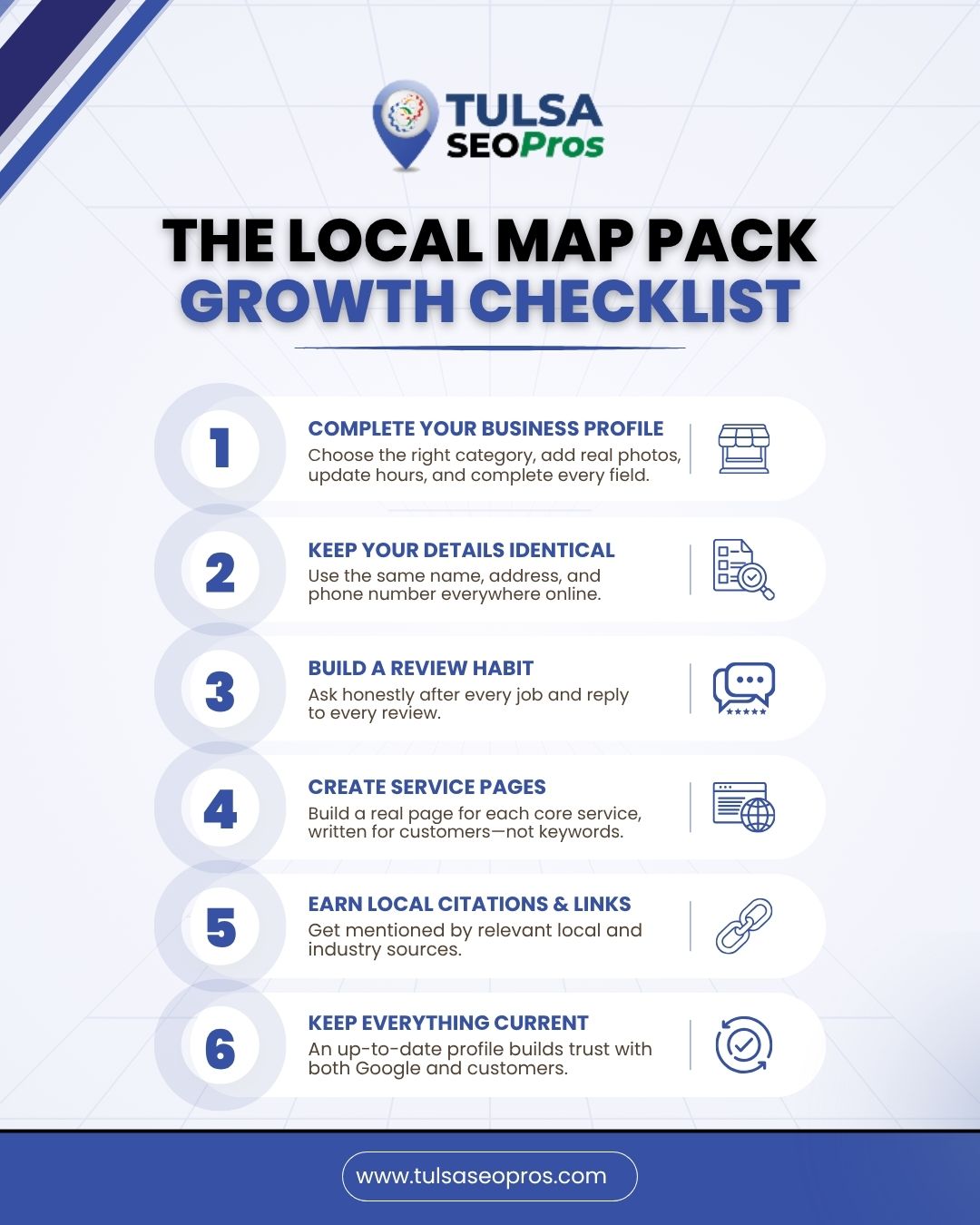
- Claim and fully complete your Google Business Profile. Right primary category, real photos, current hours, every field filled.
- Make your name, address, and phone identical everywhere they appear online. Conflicting details quietly sink you.
- Turn on a steady review habit. One honest question at the end of every job, one reply to every review.
- Build a real page on your website for each core service, written for a customer, not a keyword.
- Earn citations and links from local and industry sources, so your footprint matches your reputation.
- Keep it all current. A profile that drifts out of date loses trust with Google and customers alike.
None of these is clever, and that is the point. Done together and kept up over months, they are what pull a business into the three names people actually call, and what keep it there once a competitor notices and starts trying to catch up.
What Will Not Move You
Save your money and your time here. Paying Google for placement does nothing, because there is no such option. Stuffing your city or a keyword into your business name violates the guidelines and can get the profile suspended. Buying reviews or a burst of fake ones is a fast way to lose the profile entirely.
Adding extra words to your business name that are not your real name is another one to avoid. It might nudge you up for a week, and then a competitor reports it, and the profile gets suspended, and you lose everything you built.
Chasing a vendor’s proprietary “ranking formula” is the same trap in a nicer suit. The factors are public, the work is known, and the businesses that win the 3-pack are simply the ones doing the honest version of it consistently while their competitors hunt for a shortcut that does not exist.
What This Looks Like In Tulsa
For a Tulsa service business, the path is concrete. Get the profile complete and the category exactly right, then get the name, address, and phone matching across Google, Bing, Apple Maps, and your trade’s directory. Build reviews every week and reply to them. Put a real page behind each service on a site that loads fast.
Do that, and you hold the 3-pack for searches around your address, and you push into neighboring areas like Owasso or Bixby further than a weaker competitor sitting closer to them. The map pack rewards the business that is easiest to trust and simplest to place, which is exactly what this work makes you.
Getting into the map 3-pack
Ranking in the map 3-pack comes down to the three factors Google names out loud: relevance, distance, and prominence. You cannot move your customers or pay for placement, so you win on a complete, accurate profile, a steady stream of honest reviews, and a real website behind it all. Work the checklist above in order and keep it current. If you would rather hand the profile, reviews, and site work to a team that does it daily, Tulsa SEO Pros builds local businesses into the three names their customers actually call.