A web design proposal is mostly a price and a page list, but the lines that matter years later are the quiet ones: whose name the domain is registered under, whose account holds the theme and plugin licenses, and who stays the verified owner in Google Search Console after launch. Get those three answered in writing, and most other disputes become small. We write proposals for businesses in Tulsa, Broken Arrow, and Owasso, and this is the order we would read one in if we were on the buying side of the desk.
TL;DR
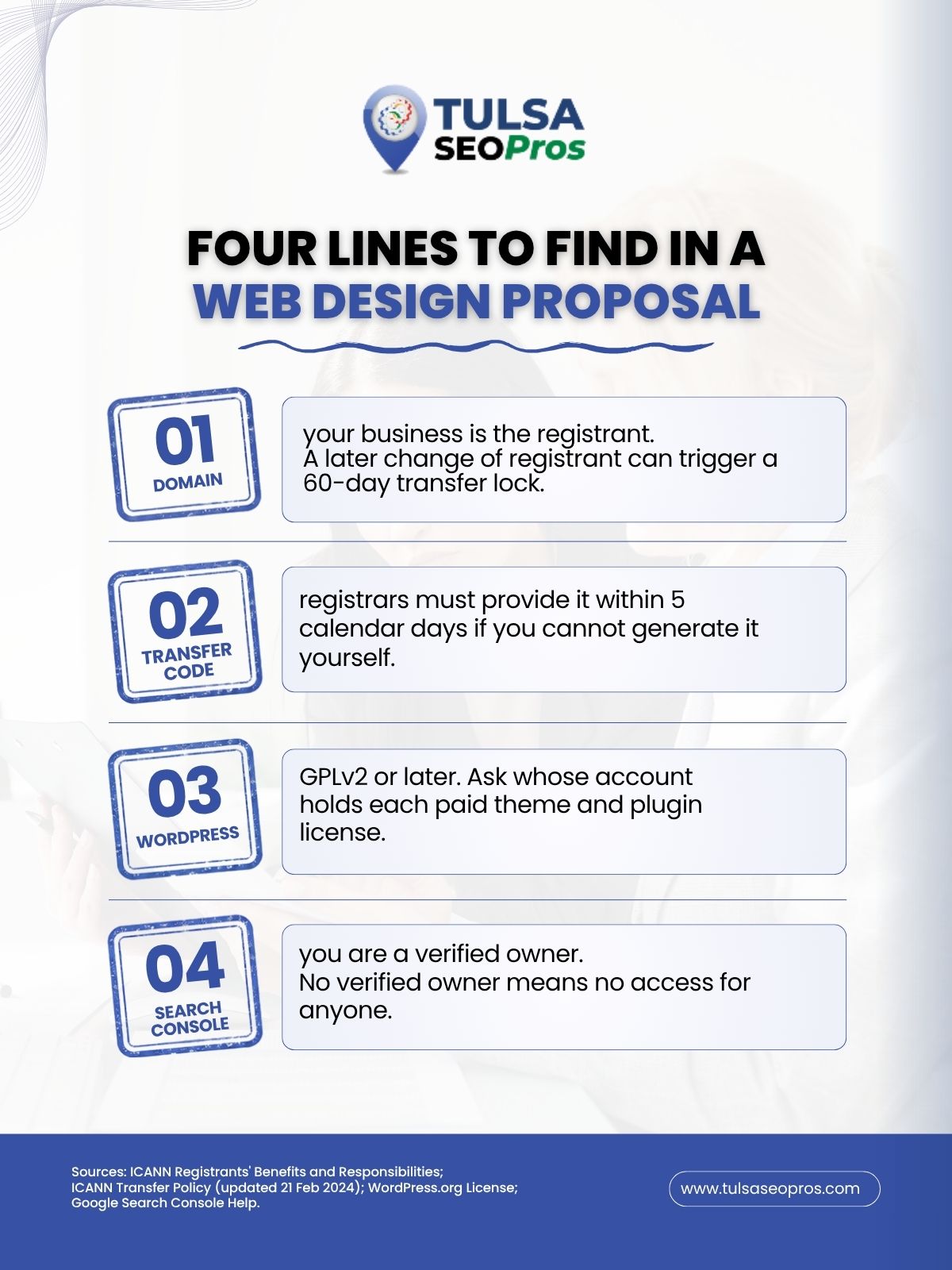
Read a web design proposal for ownership before price. The domain should be registered with you as the registrant, because ICANN’s registrant rights attach to the registrant, and a later change of registrant can trigger a 60-day transfer lock under ICANN’s Transfer Policy. The WordPress core is GPL software, and the project treats themes and plugins as derivative works that inherit that license, so ask which paid add-ons the build uses and whose account holds their keys.
Search Console needs you as a verified owner, since a property with no verified owner loses access for everyone. Then check scope: page count, who writes the copy, revision rounds, redirects for a redesign, and what happens after launch. None of this is legal advice. It is a buyer’s checklist for the business side of the deal.
Whose Name Goes on the Domain Registration?
Yours. The domain should list your business as the registrant, with an email address you control, even when the designer does the clicking.
Everything else in the proposal can be rebuilt. A domain you do not control cannot.
ICANN, the body that accredits domain registrars, publishes a short page on registrants’ benefits and responsibilities. It says every registration sits under a Registration Agreement with an ICANN-accredited registrar, and that you are entitled to review that agreement and download a copy. It also says you are entitled to clear information about who the registrar is and what it charges. The same list covers how it handles transfers, renewals, and restores.
The same page puts the weight on you, too. The registrant “will assume sole responsibility for the registration and use” of the domain, must keep contact details accurate, and must answer registrar inquiries within fifteen days. If auto-renew is on, the payment method has to stay current. Those duties land on whoever is listed, which is exactly why it should be the business.
| What the proposal says | What it usually means | What to ask for instead |
|---|---|---|
| “We will register the domain for you” | The designer may be the registrant | You as registrant, designer added as a technical contact |
| “Domain included for the first year” | Renewal terms are unstated | The renewal price and whose card renews it |
| “We manage DNS” | The designer holds the login | Your own registrar login, shared access for the designer |
| Nothing about the domain at all | It was never discussed | A line naming the registrant, in writing |
You can check today’s registration yourself. ICANN runs a registration data lookup tool that, in ICANN’s own words, lets you “look up the current registration data for domain names.” Many records are privacy-redacted, but the registrar name alone tells you where to log in.
The 60-day lock nobody mentions
Moving a domain into your name later is possible, and it comes with a wait. ICANN’s Transfer Policy, in the version registrars had to implement by August 21, 2025, requires the registrar to impose a 60-day inter-registrar transfer lock after a change of registrant, unless the registrant opted out before the change was requested.
So a handover that changes the owner name can freeze the domain at its current registrar for two months. That is fine if you are staying put. It hurts if the reason for the handover is that you are leaving the designer’s registrar account. The policy itself advises the prior registrant to request the registrar transfer first, before the change of registrant, to avoid triggering the lock.
A few more timing rules from the same policy are worth knowing when a proposal promises a “domain transfer” as part of a redesign:
- A registrar may deny a transfer requested within 60 days of the domain’s creation date.
- A registrar may deny a transfer within 60 days of a previous registrar transfer.
- If you cannot generate the transfer authorization code yourself, the registrar must provide it within five calendar days of your request.
- A registrar may not refuse to release that code solely because of a payment dispute between you and the registrar.
Read point four carefully. It protects the registrant from the registrar. It does nothing for you if a designer is the registrant and the disagreement is with the designer. That gap is the whole argument for your name on the record from day one.
Theme and Plugin Licenses in a WordPress Build
Most Tulsa small-business sites we see are built on WordPress, so this is the version of the question you are most likely to face. A proposal for one should name the theme and every paid plugin the build depends on.
The WordPress license page states that WordPress is released under the GPLv2 or later. The project’s stated position is that plugins and themes are derivative works and inherit the GPL, while admitting “some legal grey area” about what counts as derivative. Its About page lists the four freedoms the GPL grants: to run the program for any purpose, to study and change it, to redistribute it, and to distribute modified copies.
For a buyer, that has a plain meaning. The WordPress code under your site is not something a designer can license back to you or take away.
The questions that remain are about accounts, not code.
- Which theme is the site built on, and is it free or paid?
- Which plugins are paid, and whose account bought them?
- If the renewal lapses, does anything on the site stop working, or do only updates stop?
- Are any of those purchases in the designer’s name, and can they move to yours?
- Is anything custom written for your site, and does the proposal say you receive the files?
A proposal that answers those five in a short table is a proposal written by someone who expects to be replaced one day and does not mind. That is the posture you want. Our WordPress website design for Tulsa businesses page says we build on WordPress so owners can update their own text and images after launch, with training included, and a proposal should back that promise with the logins to match.
Search Console, Analytics and the Hosting Login
Search data is the part owners forget to claim. Google Search Console is where you see which searches show your site and which pages Google has indexed, and access to it runs on ownership roles.
Google’s Search Console help on owners and users describes two kinds of owners. A verified owner proved ownership with a token, such as an HTML file or tag on the site. A delegated owner was added by an existing owner without a token. Both have the same permissions, but the difference shows up when people leave.
Google says a property must have at least one verified owner, or no users will have access to it. If every verified owner is removed, the remaining users and delegated owners lose access after a grace period, and while data keeps collecting, nobody can see it until someone verifies again. That is the scenario where a designer verified the site, added you as a delegated owner, and later cleaned up their own token.
Here is the access list we would expect a proposal to hand over at launch:
| Account | Who should be the owner | Designer’s role |
|---|---|---|
| Domain registrar | Your business | Technical contact or shared access |
| Hosting | Your business, or a written hosting agreement | Admin user |
| WordPress admin | You, as an administrator | Their own separate admin user |
| Google Search Console | You, as a verified owner | Delegated owner or full user |
| Analytics | Your business account | Added user |
| Google Business Profile | Your business | Manager |
Separate named logins matter as much as the roles. A shared password means you can’t remove anyone cleanly, and the proposal should say each person gets their own user.
The Scope Lines That Set Your Real Price
Two proposals at the same total can buy very different websites. The difference hides in scope, so read these lines before you compare numbers.
- Page count and page types: “Up to 10 pages” means little until you know whether each service and each town you serve gets its own page.
- Who writes the words: Copywriting is often the line most proposals leave vague. If you supply it, budget your own time for it.
- Revision rounds: How many rounds, at which stage, and what a change after approval costs.
- Forms and where leads go: Which inbox, which phone, and whether form submissions are stored anywhere besides email.
- Redirects for a redesign: Every old URL that earns visits should point to its new home. A redesign without a redirect map is the common way a site loses the search traffic it already had.
- Timeline and who can stall it: Our own FAQ puts most custom builds at three to six weeks, depending on size, features, and feedback cycles. Feedback cycles are the part the client controls.
- Launch checklist: Mobile testing, speed, forms tested end to end, analytics firing, and the access list above handed over.
Redesign quotes deserve extra care here, since “website redesign tulsa” is one of the phrases local owners search when an old site stops producing calls. If the current site already ranks for anything, the proposal should say how those pages are kept or redirected.
If search visibility is part of why you are rebuilding, it helps to know what ranking work costs on its own. Our breakdown of what local SEO costs for Tulsa businesses separates those line items from the build, so a proposal that bundles them can be read line by line.
What Happens After Launch?
A good proposal describes the day after launch as clearly as the build. Ask what “support” covers, what it costs per month, and what happens if you stop paying for it.
Updates are the obvious part. Core software, the theme, and each plugin all receive updates, and somebody has to apply them and check the site afterward. Backups are the less obvious part. Ask where they are stored, how often they run, and whether you can download one without asking permission.
The exit clause is the part almost nobody writes. We think every proposal should answer one question in a sentence: if we part ways, what do you receive, and in what form? A full site backup, the domain in your name, your own admin logins, and the license list from the earlier section cover most of it. Our note on building a WordPress site that ranks in Tulsa covers the build side of the same decisions, if you are weighing the technical choices too.
A Red-Flag Table for Tulsa, Broken Arrow and Owasso Owners
Most bad proposals are not dishonest. They are written from habit, and habits favor the person writing them. This table pairs the phrases we see most with the one question that clears each up.
| Phrase in the proposal | Question to send back |
|---|---|
| “Site remains property of the agency until paid in full” | What exactly transfers on final payment, and when? |
| “Hosting included” | Whose hosting account is it, and can I move it? |
| “Premium theme license included” | Whose account holds the license, and does it renew? |
| “SEO-ready” | Which specific items are included, and which are a separate service? |
| “Unlimited revisions” | Unlimited within which stage, and until when? |
| “Monthly care plan required” | Is the care plan optional after launch, and what do I keep if I cancel? |
Owners in Jenks, Bixby, and across Tulsa County ask us the same things, and the answers should never be awkward to give. If a vendor bristles at a written answer, you have learned something useful before signing rather than after.
A shop building its first site and a Broken Arrow contractor replacing a ten-year-old one need the same answers. The redesign simply has more at stake, since there is existing search traffic to protect.
Ask Us These Same Questions Before You Hire Us
Hold every Tulsa web design proposal to the same checklist, ours included. Ask for the domain in your name, the license list in a table, verified owner status in Search Console, and a one-sentence exit clause. If you are also comparing ecommerce builds, our Shopify store development page is where we describe that side of the work, and the same ownership questions apply to the store account.
When you are ready for a quote that answers all of the above in writing, Tulsa SEO Pros will put each item on paper before you sign. This checklist is a buyer’s guide, not legal advice. For the final contract language, an attorney who reads contracts for a living is the right second reader.