Most commercial contractors in Tulsa think of bidding as the moment the work is won. It is closer to the end of the process.
Before a sealed bid is opened at City Hall, a contractor has to be prequalified, registered and listed. Before a private job goes out to bid, a general contractor or owner has already decided whose names go on the invitation list. This guide covers how contractors find jobs to bid in Tulsa and the surrounding county, which lists matter, and what a general contractor sees when they search your company name before sending the plans.
TL;DR
Public construction work for the City of Tulsa is advertised in the Tulsa World every Friday, requires general and prime contractors to be prequalified in one of five classifications, and is awarded through sealed bids opened on Friday mornings. Purchasing (supplies, equipment and services) runs separately and notifies registered vendors by commodity code.
Federal work needs a SAM.gov registration, renewed every 365 days, and prime contractors search the SBA’s Small Business Search profiles to find subcontractors. Certified Small Business Enterprises in the City program share a set portion of construction and professional services spending. Private commercial work is different: the owner or general contractor builds a bid list, and every name on it gets looked up online first. Search visibility cannot win a sealed low bid. It decides whether you are on the list at all.
Where Is Public Construction Work in Tulsa Posted?
The City of Tulsa posts public improvement projects on its Engineering Services construction bids page, and it advertises them publicly through the Tulsa World every Friday for six business days unless a notice says otherwise. The same page lists each open project with its bid opening date, pre-bid meeting, required prequalification classification, and any Small Business Enterprise participation target.
That page is the one to bookmark. When we read it on September 28, 2026, it listed a waterline replacement between 31st and 41st Street near Lewis Avenue, an arterial street rehabilitation on South Cheyenne Avenue, sewer rehab work, and a roof replacement on the Mohawk filter press building, with openings on October 2 and October 16.
The Friday rhythm
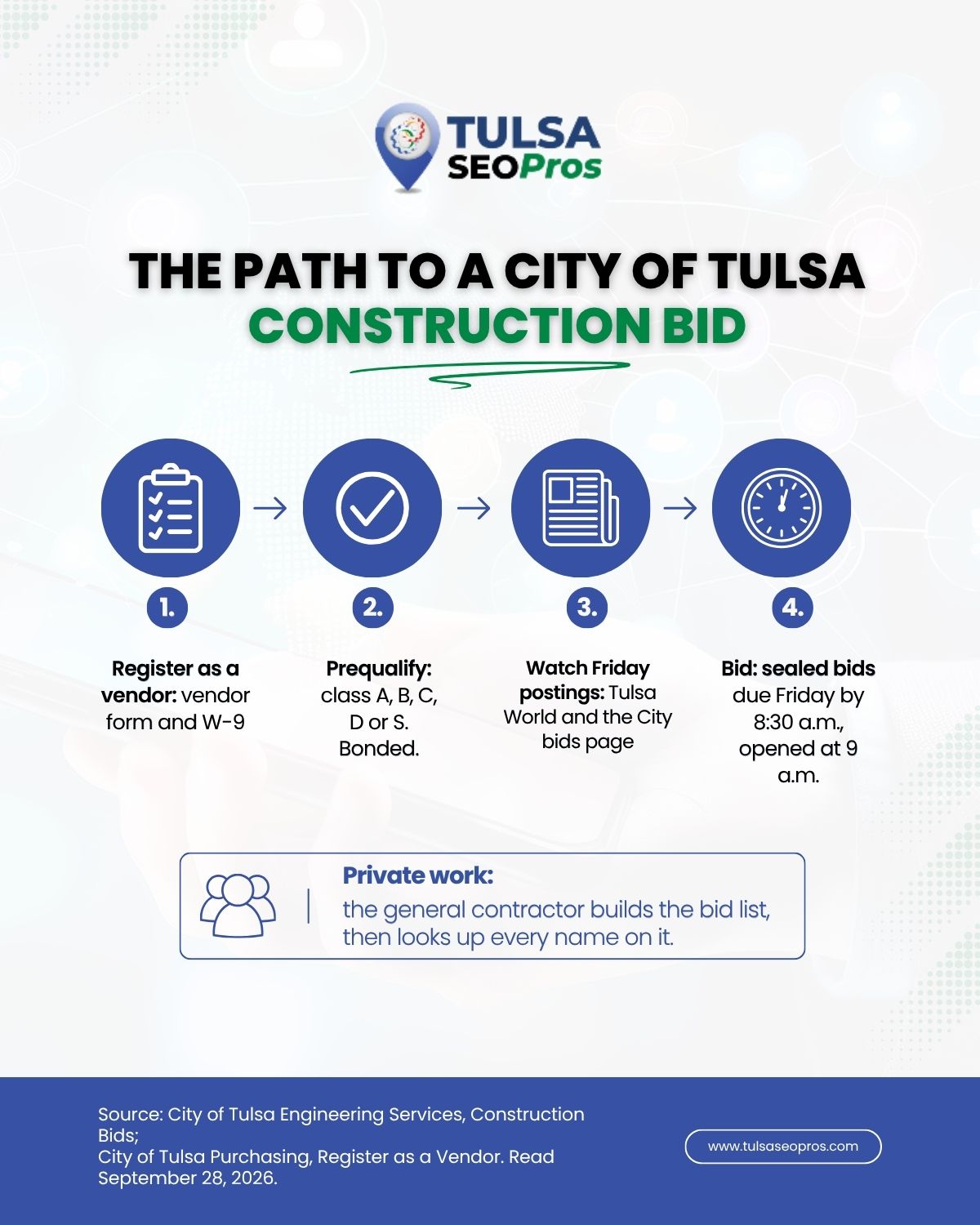
Sealed bids come in to the City Clerk’s office at 175 East 2nd Street by 8:30 a.m. on Friday and are opened publicly at 9 a.m. in the City Council chambers.
Bids received more than 96 hours before the opening are not considered. Addenda are the bidder’s job to track, and the City says so plainly.
Two private plan rooms carry City bid documents as well: Southwest Construction News on South 33rd West Avenue and Bid News on South Garnett Road.
| What | Where it happens | When |
|---|---|---|
| Public notice | Tulsa World, plus the City’s construction bids page | Every Friday, six business days |
| Pre-bid meeting | Listed per project, many with a virtual link | Weeks before opening |
| Sealed bid due | City Clerk, 175 East 2nd Street, Room 260 | Friday by 8:30 a.m. |
| Public opening | City Council chambers, City Hall | Friday at 9 a.m. |
Purchasing is a separate lane. Supplies, equipment, and non-construction services go through the Finance Department’s Purchasing Division, which emails registered vendors when a new solicitation matches the commodity codes they picked. If a Broken Arrow mechanical contractor also sells service agreements, both lanes can apply.
Prequalification Decides Who Can Even Submit
Here is the step most contractors skip until a job they wanted is already out. The City requires general and prime contractors to be prequalified under Title 11, Chapter 11 of its ordinances, unless the notice to bidders says prequalification is not required. Every general or prime contractor must also be bonded.
Prequalified contractors carry at least one of five classifications:
| Classification | Covers |
|---|---|
| A | General |
| B | Building construction |
| C | Paving and bridge construction |
| D | Utility construction |
| S | General or specialty |
Each project names the classes it accepts. The filter press roof, for example, called for A or B. The street rehabilitation called for A or C.
So the order of operations runs backwards from how most firms think about it:
- Register as a vendor with the City (the vendor form plus a W-9).
- Submit the prequalification application and checklist.
- Get on the Contractor’s Prequalification Committee schedule and keep the renewal current.
- Watch the Friday postings for projects in your class.
A firm that starts at step four finds a project it wants and then learns it cannot submit. Nothing about your website changes that.
Why Search Rankings Never Win a Sealed Bid
We will be direct about this, because it is where a lot of contractor marketing money gets wasted. On an Invitation for Bid, the City’s published vendor FAQ says the award typically goes to the lowest price that meets the specifications. There is no negotiation of material requirements or contract terms. A better website does not lower your number.
Requests for Proposal and Competitive Sealed Proposals work differently. The City’s vendor FAQ describes those evaluations as weighing experience, staff capacity, methodology and past performance alongside price, with each factor’s weight set out in the solicitation.
That second kind of evaluation is where your public record starts to matter. Nothing about it is scored as a search result, though. The proposal is scored. What the evaluator already knows about your firm, and what they find if they look, colors how they read it.
The honest line, then:
- Sealed low bid: marketing has no role in the award.
- Qualitative proposal: your documented project history supports the proposal.
- Private invitation list: visibility and reputation decide whether you get the plans.
That third one is the big one for most commercial subcontractors in Tulsa County, and it is the part this article is really about.
The Invitation List Is Built Before Anyone Calls You
Private commercial work rarely has a public notice. An owner, developer, or general contractor decides which subcontractors will receive the drawings, and that list is built from people they know, people they have been referred to, and firms they have checked out.
Checked out is doing the work in that sentence.
A project manager with a name from a supplier or another sub will search it. They are not looking for a slogan. They want to see the kind of buildings you have worked on, whether you have done work at that size, where you work, and whether you look like an established firm or a truck and a phone number. If your company does not come up for its own name, or comes up with a stale page listing residential remodels when you now bid tenant finish-outs in Jenks and Bixby, that is a quiet no.
Public programs that feed private lists
Two programs send general contractors looking for subs by name, which puts your search presence to work.
The City’s Small Business Enterprise program directs 10% of construction and professional services to certified SBEs. Certification requires more than a year in operation, a three-year average of under $3 million in sales or under $5 million in construction income, independent for-profit ownership, and a physical address in Tulsa, Osage, Rogers, Pawnee, Wagoner, Creek, or Okmulgee County.
The program publishes an SBE directory, and individual projects carry a participation target. The South Cheyenne street rehabilitation listed one, which means the prime needs certified subs to meet it.
A prime working that target will pull names off the directory and then search each one. Being listed gets you considered. Your website and Business Profile decide how quickly you get the call.
| Program | Who searches it | What they do next |
|---|---|---|
| City of Tulsa SBE directory | Primes on projects with an SBE target | Search the firm name, check capability and past work |
| SBA Small Business Search | Federal prime contractors | Read the capabilities narrative, then the website |
| Plan room and bidder lists | General contractors and estimators | Confirm trade, size, and service area |
Federal Jobs Start With a SAM Registration
Federal jobs in Oklahoma all share one front door, whatever agency is buying. To bid on a federal contract or apply for a federal award as a prime, a business needs a registration on SAM.gov, the federal System for Award Management. Registration assigns a Unique Entity ID, must be renewed every 365 days, and can take up to 10 business days to become active.
Subcontractors may not need the full registration. SAM.gov notes that some transactions, such as reporting as a sub-awardee, only need a Unique Entity ID, which requires just the legal business name and physical address. The catch is that without a registration, you cannot apply directly for federal awards.
The more interesting piece for getting found is the search profile. The SBA’s page on prime contracting and subcontracting says prime contractors use the Small Business Search to find small businesses. It tells small firms to complete that profile with their certifications, a capabilities narrative, keywords, NAICS codes, and performance history.
Read that list again, and it is a search engine listing. Keywords, a description of what you do, and proof you have done it before.
We treat the Small Business Search profile, the City vendor registration, and your own website as one set of descriptions that should match. Same legal name, same trades, same project types.
A prime who finds you in the SBA database and then lands on a website describing different work has a reason to hesitate.
Free help exists
SAM.gov points small businesses to APEX Accelerators, formerly called Procurement Technical Assistance Centers, for free help completing registration. That is a better use of an afternoon than paying anyone to fill in a federal form.
What a General Contractor Should Find When They Search Your Name
This is where marketing earns its place in commercial contracting. The checklist below is what we build toward for a commercial sub or specialty contractor, and it maps to the questions an estimator is actually asking.
- Your company name returns your own site first, with a Google Business Profile beside it showing your service area across Tulsa, Broken Arrow, Owasso, and the rest of the county.
- A projects page organized by building type, with the town, the scope, and the size for each job you are allowed to name. Photos you own.
- A capabilities page written the same way as your SBA capabilities narrative, listing trades, NAICS codes, and the prequalification classes you hold.
- Your SBE certification and bonding status stated where a prime can see them, if you have them.
- A contact route that reaches an estimator, not only a general inbox, with a phone number that is the same everywhere your firm is listed.
- Pages written for commercial searches, separate from residential work, so a facility manager in Jenks does not land on a kitchen remodel gallery.
None of this requires you to rank for a head term like “commercial contractor.” The general contractor already has your name. The job of the site is to confirm, in under a minute, that you are the firm they were told about.
A site built for that confirmation is a different build from a lead-generation site for homeowners. Our notes on building a WordPress site that ranks cover the structure side, and for firms that need a project database or estimator portal, custom web development handles what an off-the-shelf theme cannot.
Search terms that bring commercial inquiries
Some commercial work does arrive through search, often from property managers and building owners. Those searches name a building type or a problem, plus a place. Think “tilt-wall repair Broken Arrow” or “commercial roof coating Tulsa”.
Service pages built around the work you want, in the towns you want it, are what catch them. The local ranking side of that follows the same rules as any other business, which is why we point contractors to our breakdown of what moves a business into the map pack.
A Smaller Firm Can Look Like a Safe Pick
Size is a worry that shows up in how many smaller contractors describe themselves online. A small crew with a clean record hides behind vague copy, as if a general contractor only wants a big name.
Mostly, the prime wants proof. The SBE target exists precisely so primes bring in smaller Tulsa-area firms, and the SBA explicitly asks for performance history in the federal profile. A small firm that shows its work plainly competes on the thing primes are actually checking. There is more on how smaller firms compete with larger brands in local search, and the same logic carries into commercial work: specific beats big.
| Instead of | Show |
|---|---|
| “Quality commercial construction since day one” | Three named projects with town, scope and square footage |
| “Serving all of Oklahoma” | The towns and counties you actually work in |
| “Fully licensed and insured” | The prequalification class, bonding and SBE status you hold |
| A stock photo of a crane | Your crew on your job |
Get on Tulsa Bid Lists, Then Make the Lookup Easy
Start with what costs nothing. Register as a City of Tulsa vendor, submit the prequalification application for the classes you can hold, and apply for SBE certification if your firm qualifies. If federal work is in your plans, register on SAM.gov, finish the Small Business Search profile, and book time with an APEX Accelerator. Put the renewal dates on the office calendar.
Then fix what a general contractor finds when your name comes up. If your site still reads like a residential contractor, or does not show the work you want more of, our marketing for construction companies starts with that lookup and works outward. Tulsa SEO Pros will review your site, profile, and listings against the lists above and tell you what a prime would see today.