When someone asks ChatGPT or Google’s AI for a plumber or a roofer in Tulsa, the assistant is not reading a secret ranking. It pulls live web pages and business listings, then names the companies it can actually verify: the ones with accurate details everywhere, real recent reviews, and clear pages that answer the question. There is no hidden setting to buy, and the businesses winning here are the ones that were already easy to trust.
TL;DR
To get recommended by AI, be the business that is simplest to verify. Keep your listings identical across Google, Bing, Apple Maps, and your trade’s main directory. Earn genuine reviews and reply to them. Write a plain page for each service that answers the question head-on. Then keep all of it current.
No separate AI discipline exists to buy. Google’s own documentation says appearing in its AI answers takes no special optimization, no special schema, and no new files. Anyone selling you a proprietary AI package is selling something Google itself warns against. The work that earns an AI mention is the local-search work you already needed to do.
AI Became The Third Way People Find Local Businesses
The behavior shifted fast. BrightLocal’s 2026 Local Consumer Review Survey found the share of people using AI tools to find local businesses jumped from 6% to 45% in a single year, which puts AI third behind Google and Facebook as a discovery channel. A plan written for the blue links alone is already behind where customers are looking.
The answers also swallow more of the attention than the old results did. Pew Research Center, studying about 69,000 searches from 900 US adults, found that when an AI summary appeared, people clicked a regular result on just 8% of visits versus 15% without one, and 26% ended their session right there instead of 16%. When the AI answer is the whole interaction, being the business it names is the difference between a call and silence.
That is the shift in one line. Fewer clicks to go around, and a machine, not a page of ten links, deciding which handful of businesses even get mentioned at all.
How ChatGPT Actually Names A Business
The mechanic is not what most people assume, and understanding it changes what you do about it. ChatGPT keeps no fixed leaderboard of plumbers. When you ask, it retrieves live pages and listings, writes an answer, and cites what it leaned on. The businesses that make the cut are the ones easiest to confirm.
That means your listings feed the answer as much as your website does. Directories the assistants read get pulled in constantly, and a business that only ever tended its Google profile is invisible to a large slice of AI lookups. This is the same trust-building work behind our AI SEO service: make the whole web agree about who you are, so the machine has nothing to doubt.
Verifiable beats clever here. An assistant would rather name the shop with a plain, consistent record than the one with the flashiest website and a muddled trail behind it.
One practical upshot follows from all of this. If a customer could not tell in ten seconds who you are, where you work, and exactly what you fix, then neither can the model reading your pages. The two audiences want the same thing, which is why writing plainly for the impatient human is the whole trick. Clarity is the format the machine prefers, and you never have to guess at it.
The Listings The Assistants Actually Read
Coverage is where most local businesses quietly lose. Google Business Profile matters, but it is not the whole board. Bing’s local index sits behind ChatGPT’s live lookups, Apple Maps feeds Siri and a growing share of in-car and iPhone searches, and Yelp and the big directories turn up again and again as the sources AI answers cite.
Claim them all, and make them say the same thing. Strong local SEO in Tulsa is largely this: the same name, address, phone, hours, and categories on every platform that an assistant might check. Miss Bing and Apple Maps, and you have handed the AI answer to a competitor who did not.
There Is No Secret AI Setting
Here is the part vendors would rather you did not know. Google’s guidance on AI features and your website states in plain language that there are no additional requirements to appear in AI Overviews or AI Mode, and nothing else special to do. Its generative AI guide adds that this kind of search does not call for structured data or any special markup, and that content people find genuinely useful will shape your presence in AI answers more than any technical trick.
Read that twice, slowly. There is no separate file to publish, no magic schema, and no hidden switch anywhere.
It undoes a lot of noise, and it is good news, because it means the effort is not doubled. The page that helps a human who lands on it cold is the same page an assistant will quote. Do the honest work once, and it pays in both places.
Get Your Details Identical Everywhere
Because assistants cross-reference sources before trusting any of them, consistency is not housekeeping. It is the trust signal. If your hours read one way on Google, another on Yelp, and a third on your own site, the AI treats the disagreement as unreliability and quietly leaves you out of the answer.
The fix is unglamorous, and it works. Pick the platforms that matter, make every field match, and update them the moment something changes.
Watch the details that drift without anyone noticing. A phone number changed after a rebrand, a suite number added, a holiday hours edit made on Google but nowhere else. Each small mismatch chips at the confidence an assistant has in your record, and enough of them drop you out of the answer entirely. This is the single most common reason a perfectly good local business never gets named, and it costs nothing but attention to fix.
Reviews Do The Heaviest Lifting
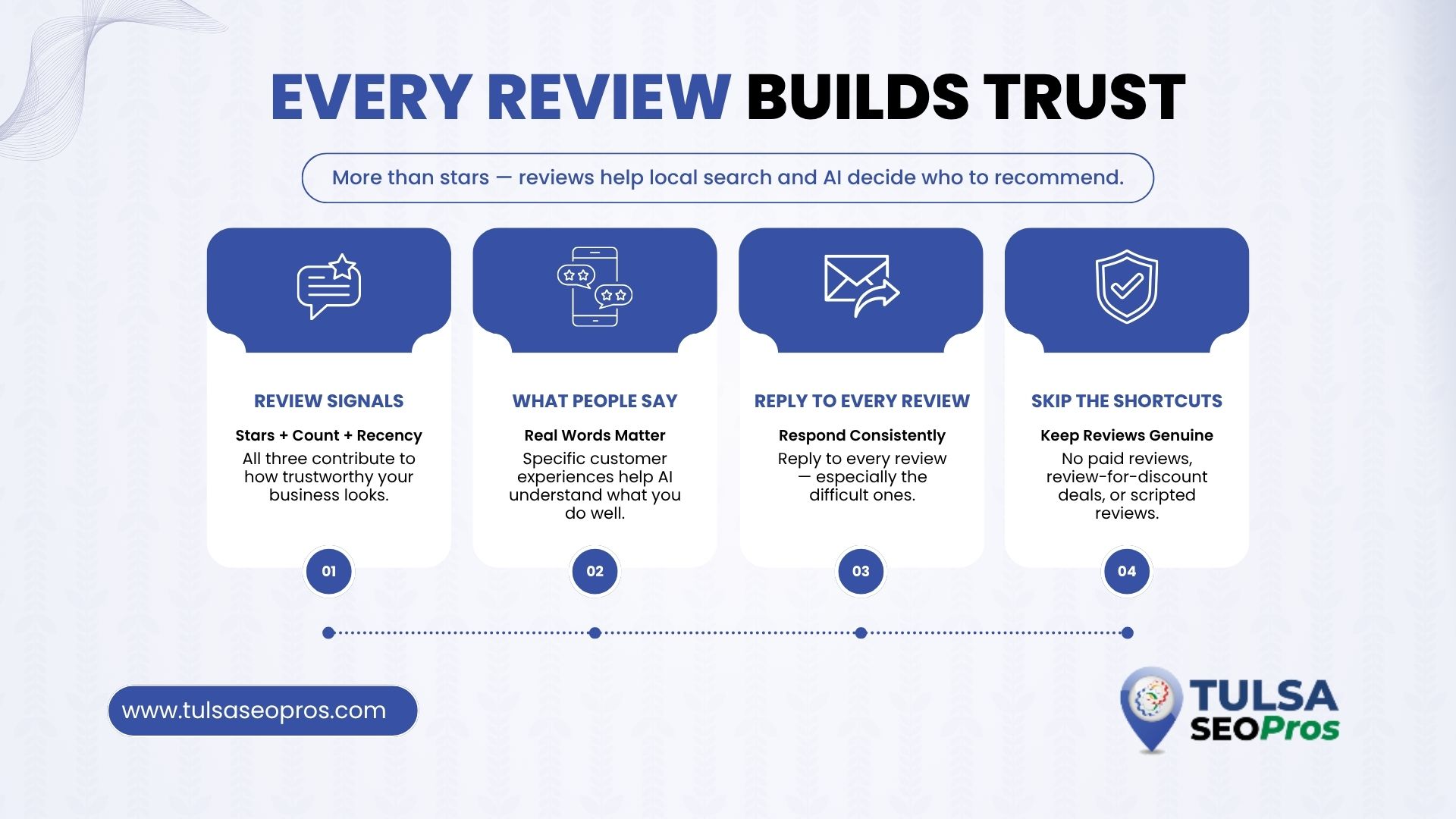
Reviews feed both the local ranking and the AI recommendation, and they carry more weight here than almost anything else you control. It is not only the star average. The count, the recency, how often you respond, and what reviewers actually describe all shape whether an assistant reads you as a safe answer.
Build the habit honestly. Every finished job ends with a friendly request and a direct link, and every review earns a reply- the rough ones most of all.
Skip the shortcuts, because they backfire hard. Paying for reviews, trading a discount for one, or scripting your staff to post them breaks platform rules and puts the whole profile at risk. An incentivized review now has to be clearly disclosed before it can even carry rating markup. Genuine reviews are the only kind worth chasing, and they happen to be the ones the AI trusts anyway.
Be The Clearest Answer On The Page
If an assistant is going to quote you, your pages have to be quotable. Answer the real question directly, near the top, in plain language, instead of burying it under a paragraph of throat-clearing. A page that opens by stating what a service costs, what it includes, and who it is for hands the AI something clean to lift.
Write a real page for each service and each question a customer asks. Those are the same pages that help the worried homeowner who found you at eleven at night.
Clarity and substance are the whole job. There is no clever formatting that rescues a thin page, and no thin page that survives a reader who needed a real answer. Answer the question better than the other results, and you become the answer the machine repeats back.
Ignore The AI Optimization Sales Pitch
This is where to guard your budget. Google’s guidance on third-party SEO tools and services names “AEO” and “GEO” tools directly, and warns that these third parties have no access to its internal ranking data and cannot promise performance. No tool buys you an AI citation. Full stop.
That does not make the work fake. There is a real, honest version: accurate listings, clear content, steady reviews, and genuine authority in your field. That is exactly what our answer engine optimization services are: the fundamentals done well and kept up, not a secret AI product with a monthly fee and a promise nobody can keep. If a pitch leans on a proprietary setting or a promised AI ranking, walk away.
A Simple Order To Fix This This Month
You do not have to do everything at once. Work it in this order, and each step makes the next one land harder.
Start with the listings, because they gate everything else. Claim Google, Bing, Apple Maps, and the one directory that owns your trade, then make every field match to the letter. This is the least glamorous hour on the list and the highest paying.
Next, switch on a steady review habit. One honest ask at the end of every job, one reply to every review that lands. It compounds quietly.
Then fix your pages. Give each service its own page that answers the real question in the first two lines, the way a customer would ask it. For a roofer, a page that opens by explaining what hail damage looks like is quotable, while a vague services page is not, which is the same logic behind our roofing marketing work: one clear page per real question.
Last, keep it current. A profile that drifts out of date is a profile the AI slowly stops trusting. Ten minutes a month protects everything the other steps built.
What This Means For A Tulsa Business
Put together, the path for a Tulsa shop is refreshingly concrete. Get named right across Google, Bing, Apple Maps, and your trade’s main directory. Earn reviews steadily and reply to them. Publish a clear page for each service that answers the question a neighbor would actually ask. Then keep the whole thing current.
Picture the actual moment. A homeowner in Broken Arrow with a leaking water heater opens their phone and asks for a plumber, and the assistant reads the web in a second and names two or three shops. You are in that answer, or you are not, and nothing about it feels like the old ten blue links.
Do the fundamentals, and you win that moment, and you win the matching Google AI answer for the same search, off one effort instead of two. The trades pulling ahead in AI search in 2026 did not buy a clever tool. They were simply the easiest businesses in town to trust and the simplest to verify, and the machines rewarded exactly that.
Make your business the easy answer
Getting recommended by AI is not a new discipline bolted onto your marketing. It is your local fundamentals paying off in a second place. Line up the listings so every platform agrees, build honest reviews, and write pages that answer the question straight, and you become the business the assistant can name without hesitation. Skip anything sold as a secret AI setting, because Google’s own docs say there is not one. If you would rather hand the listings, reviews, and content work to a team that does it every day, Tulsa SEO Pros builds this kind of trust across search and AI answers alike.