TL;DR
Administration’s marketing budget guidance points to consumer-facing service businesses averaging about 11.8% of revenue, and plumbing sits squarely in that group. The percentage itself is the easy part. Where the money actually goes decides everything, because a budget poured into shared lead lists funds someone else’s business, while the same money put into your own Google ranking, reviews, and website builds an asset that keeps sending calls after you stop paying. This guide walks through what a plumbing marketing budget should cover, what a lead really costs by channel, and the order to spend in so nothing gets wasted.
Start With The Percentage, Then Ignore It
A budget percentage is a fine place to begin and a poor place to stop. The SBA’s marketing budget guidance puts consumer service businesses near 11.8% of revenue, a figure drawn from 2018 data, and plumbing shops competing in busy metros often sit toward the higher end of that band. A company doing a million a year, then, is looking at roughly a hundred thousand for the year, or a little over eight thousand a month.
Useful as a guardrail, useless as a plan. Two plumbing companies with identical revenue can need very different budgets, because the shop in a crowded suburb with three competitors bidding on every keyword faces a different fight than the shop that quietly owns its town. The percentage sets your ceiling. What you do underneath it decides whether the money works.
Timing bends the number too. A newer shop trying to get known has to spend more up front, while an established shop with a deep referral base can coast more on reputation and reinvest less. Where you sit in that arc moves the right figure more than your revenue does, so treat that figure as a starting line, not a target.
What A Plumbing Lead Costs By Channel
Cost per lead is where the real decisions live, and the cheapest number on paper is rarely the cheapest customer once you count how many actually close. The channels sort out like this.
| Channel | Relative cost | Who the lead belongs to |
| Organic local search | Cheapest once established | Only you |
| Local Services Ads | Mid, charged per lead | Only you |
| Google Search Ads | Mid to high per click | Only you |
| Shared lead lists | Looks mid, resold | You and several competitors |
| Referrals and repeat | Nearly free | Only you |
Organic search is the cheapest lead once the ranking is earned, because after that each new call costs almost nothing. It is also the slowest to build, which is why sensible shops run paid ads while the ranking grows, then lean off paid as the free traffic climbs. Shared lists look reasonably priced until you notice the same homeowner is fielding calls from four plumbers, which quietly drags down your close rate and drives up the true cost of every booked job.
Emergency work bends all of it. A burst pipe at midnight is a high-value job, and the homeowner calls whoever appears first and answers, so paid placement and fast response pay for themselves on those searches. A planned water heater swap gives you more time, so organic and reviews carry more of the weight there.
Where Your First Dollar Should Go
If your plumbing marketing budget is tight, and most are, spend in this order. The point is to fix the channels that convert traffic before you pay to send more of it.
First, the Google Business Profile, because it decides whether you appear in the local map pack, and it is close to free. Second, reviews, since a steady flow of them lifts both your ranking and your close rate. Third, the website, because every paid click and every search visit lands there, and a slow or confusing page wastes them all. Only once those are solid does paid advertising earn its place, because now the traffic you buy has somewhere good to land.
Skipping that order is the most common way plumbing companies burn money. They buy ads while the site loads slowly and the profile sits half-filled, then blame the ads when the leads do not close. The ads were fine. The foundation under them was not.
Why Local Search Lowers The Whole Budget
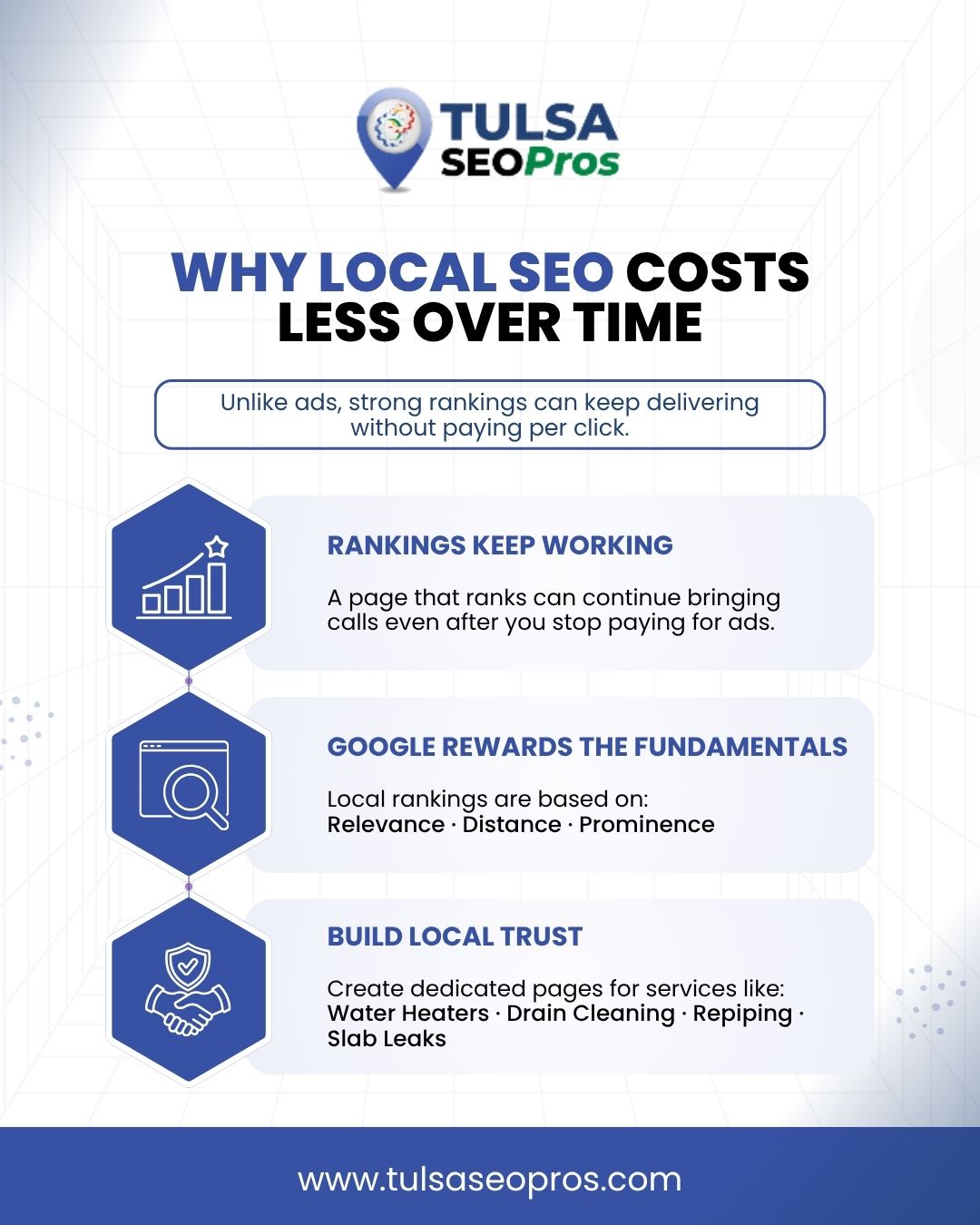
The reason to obsess over local search is that it is the one channel that gets cheaper as it grows. Every other line resets each month, but a page that ranks keeps ranking, and the calls keep arriving after you stop paying.
It helps to know how the map pack is actually judged. Google’s own guidance on how local results are determined says ranking comes down to relevance, distance, and prominence, and states plainly that there is no way to pay for a better local ranking. That is good news for a plumbing shop, because it means the work is earnable: a complete Business Profile, consistent business details across the web, and a real page for each service- water heaters, drain cleaning, repiping, slab leaks- rather than one thin list.
Getting your name, address, and hours to match everywhere sounds dull, and it is, but conflicting details are exactly what make the search engines lose confidence in where you are. Strong local SEO in Tulsa is mostly these fundamentals done steadily, month after month, and it is what eventually lets you spend less on ads without losing calls.
Reviews Earn Their Place Twice
Reviews do two jobs at once, which makes them the best return in the whole budget. They feed the prominence signal Google weighs for ranking, and they close the customer once the customer is looking.
The closing half is easy to underrate. In BrightLocal’s 2026 Local Consumer Review Survey of 1,002 US consumers, 85% said they are more likely to use a business after reading positive reviews. Two plumbing shops sit side by side on the map, one with a long run of recent five-star reviews and one with a handful from two years ago, and the homeowner calls the first one almost every time.
Steadiness beats a big one-time pile. Build a simple habit: every finished job ends with a friendly request and a direct link, and every review gets a reply, the rough ones especially, because the next reader studies your response more closely than the complaint. Skip the shortcuts here. Paying for reviews or scripting staff to post them breaks platform rules and puts the profile at risk, and it is never worth it.
Your Buyers Now Ask AI, Too
Search is not the only front anymore. That same BrightLocal survey found that AI tools jumped to the third most common way people find local businesses, and that 42% now trust an AI recommendation about as much as a personal referral. A plumbing marketing budget written for Google alone is already a step behind.
Here is the good part: there is nothing special to buy. The AI assistants lean on the same accurate, consistent business information the map pack already rewards, so keeping your name, services, and hours correct everywhere is what earns the mention. No secret setting, no separate spend. Do the local search fundamentals well, and you show up in both places for the price of one.
That is worth stating plainly because plenty of vendors will try to sell you a separate AI package. The honest answer is that the accurate profile and the real service pages you already need are the whole job.
The Oklahoma Freeze Reshapes The Calendar
Plumbing demand is seasonal, and a flat budget spread evenly across twelve months wastes money in the quiet stretches and misses the spikes. Around Tulsa, the hard freezes from December through February drive a wave of burst pipes and no-water calls, and that is when the high-intent searches surge. Push hardest then.
Spring and summer shift the work toward water heaters, remodels, sewer and drain issues, and outdoor lines. The demand is steadier and less panicked, so organic content and reviews do more of the lifting while paid spend can ease back. A frozen pipe page published in November, ranking before the first cold snap, earns calls all winter, while the same page thrown up in January is already late.
Plan the budget a season ahead, heavier into the freeze, lighter in the calm months. You get more out of the same annual figure by meeting demand when it actually shows up.
Track Cost Per Booked Job, Not Leads
A lead count tells you almost nothing on its own. What matters is what a booked, paying job costs, and which channel produced it. Most plumbing companies cannot answer that, so when money gets tight, they cut the wrong line.
Put call tracking on your main number and simple conversion tracking on your booking form. Within a few weeks, you can see which searches, pages, and campaigns turned into real jobs and which just spent money. Then move budget toward what books work and starve what does not. A team that runs your Google Ads and Local Services Ads can pair that tracking with the ad spend so you are paying for jobs, not clicks.
This is the whole difference between spending on marketing and investing in it. One is a bill you resent every month. The other is a system you tune, and it gets cheaper as you tune it.
A Simple Way To Split The Number
Once you have your total, a rough split keeps the money pointed the right way. Put the largest share into building and holding local search and reviews, since that is the part of the budget that compounds instead of resetting each month. Carve out a solid block for paid ads, weighted toward Local Services Ads and the high-value emergency terms where speed wins the job. Keep a smaller slice for the website and content that every other channel depends on, and a little for the referral and repeat-customer program that quietly produces your cheapest work.
Those proportions shift with your stage. A new shop leans harder on paid to get known fast. An established shop with a deep review base leans on organic and referrals and spends less overall. Revisit the split every quarter against your cost per booked job, and let the results move the money rather than habit. The plumbers who treat the budget as a living thing, adjusted each season and reviewed each quarter, pull ahead of the ones who set a number in January and never look at it again.
There is one more line worth protecting: a small reserve for the slow month you did not see coming. Marketing that gets yanked the moment cash tightens loses exactly the momentum it spent months building, and rebuilding a ranking costs far more than holding it. A steady, smaller spend beats a big push followed by a long silence.
Where to start
Set your number near a tenth of revenue, weight it toward the channels you own, and fix your Business Profile, reviews, and website before you buy a single click. A plumbing marketing budget spent in that order produces a falling cost per job and a pipeline that does not depend on lists reselling your customers. Read our complete plumbing marketing guide for the channel-by-channel detail, and if you would rather hand the plan to a team that runs it and reports on what each dollar returns, our plumbing digital marketing agency work at Tulsa SEO Pros is built for exactly that.