To sell more golf carts online in 2026, a dealer needs three things working together: a website that shows finished custom builds instead of a bare inventory grid, search visibility so buyers around Tulsa and Grand Lake find you before a competitor, and a follow-up habit that replies to every web lead inside an hour. Golf cart shopping starts on Google and ends with whichever dealer answers first. The market is growing close to eight percent a year through 2034 as street-legal LSVs take off, so the demand is real. The dealers winning it are the ones who treat their website as a salesperson, not a brochure. Partnering with a specialized golf cart digital marketing agency can help dealers attract qualified buyers, improve online visibility, showcase custom builds effectively, and turn website visitors into more sales opportunities.
Where Most Golf Cart Websites Lose The Sale
Walk through ten golf cart dealer websites, and you will see the same thing nine times: a photo of a stock white cart, a phone number, and a page titled inventory. That page speaks to nobody. A retiree in a 55+ community near Bixby, a dad hauling kids around a lake lot at Grand Lake, and a small business owner who wants a street-legal LSV for a resort property are three different buyers with three different reasons to spend money. A single generic page treats them as one.
The dealers pulling ahead build for the specific buyer and the specific use. That is the whole game, and it costs nothing but the effort to think like each customer. Below is how the pieces fit, from the first Google search to the follow-up call that closes the deal, in the order a real buyer moves through them.
Why Your Inventory Page Is Not Enough
An inventory grid answers one question: what do you have in stock right now? It does not answer the questions buyers actually type before they visit. People search for street-legal carts, lifted carts for hunting, carts that seat six, financing terms, and whether a cart is legal on their neighborhood streets. If your site has no page that answers those, Google has nothing to rank, and the buyer has no reason to pick you.
Most first-time LSV owners do not know they have to register the vehicle with the DMV. A dealer who explains that on the website, or handles the paperwork in-house, removes the biggest hesitation in the sale before the buyer ever calls. That single page of help does more selling than a dozen stock photos.
Content like this also feeds AI answers. When someone asks an assistant about street-legal carts in Oklahoma, the sites with clear, specific pages get pulled into the response. This is why we build cart dealers’ real content pages and back them with answer engine optimization, so the site shows up in both Google and the newer AI search tools. A bare inventory grid gets skipped by both.
Sell More Golf Carts Online By Matching The Buyer
The fastest way to sell more golf carts online is to stop selling carts and start selling outcomes. A family does not want a lithium 48-volt drivetrain. They want a safe way to get four kids and a cooler down to the dock. Write the page for the dock, not the drivetrain.
Here is how the same cart reads to different buyers:
| Buyer | What they search | What the page should show |
| Retiree in a 55+ community | street legal golf cart near me | Comfort, turn signals, easy step-in, neighborhood legality |
| Lake family at Grand Lake | golf cart to haul kids and gear | Six-seater, cargo bed, safe for kids, rugged tires |
| Hunter or camper | lifted golf cart for hunting | Lift kit, camo wraps, off-road tires, range |
| Resort or rental owner | golf cart fleet for rental property | Durability, fleet pricing, service plan, branding |
You do not need a separate cart for each buyer. You need a separate page that frames the same inventory around what that buyer came to solve. Five or six of these pages, each built for one real customer, will outsell one bloated catalog every time. They also give Google five or six doors into your site instead of one.
Search Is Where Oklahoma Cart Buyers Start
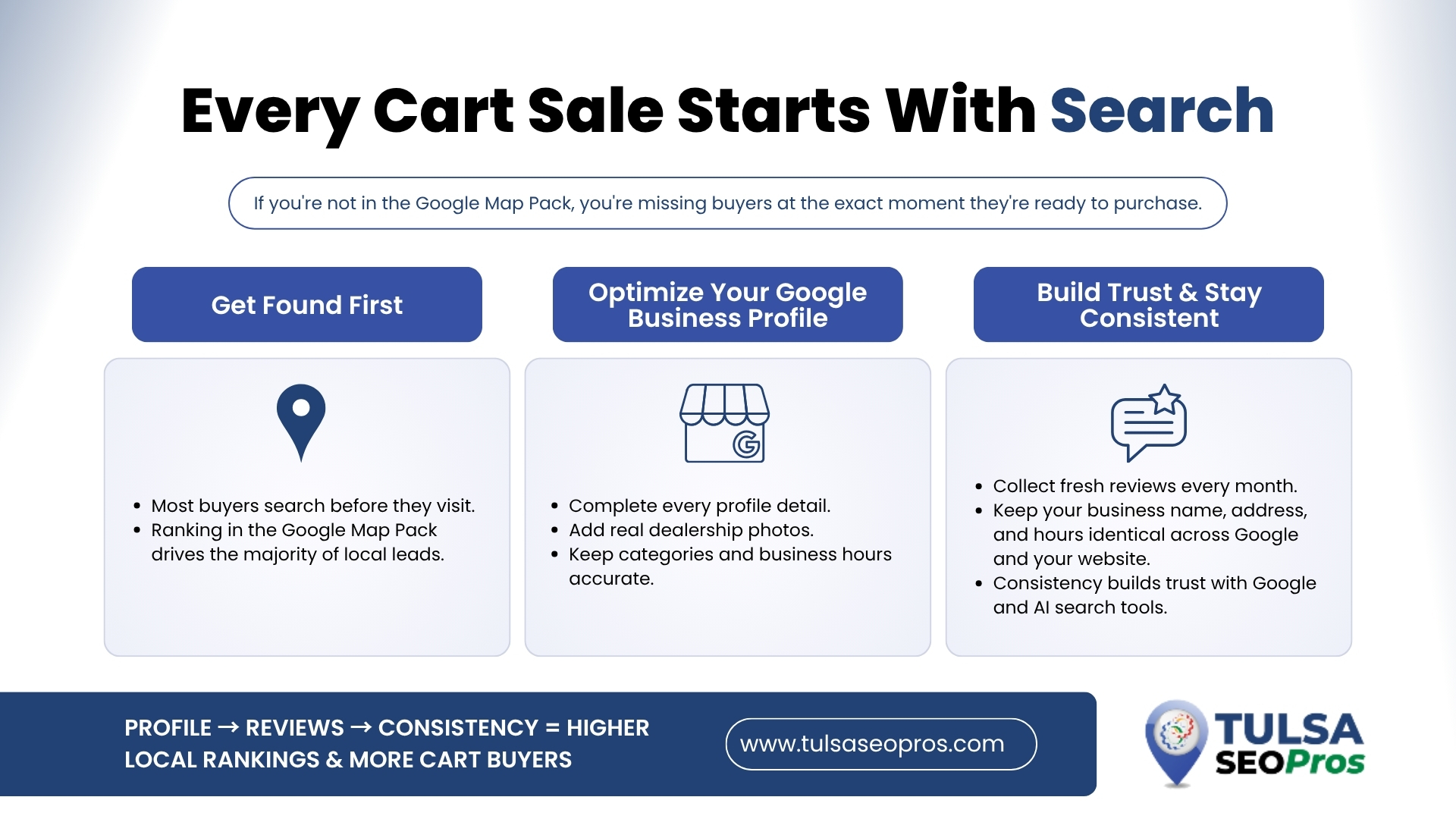
Almost every cart purchase begins with a search. Someone types golf carts near me or street legal golf carts Tulsa, then picks from the map and the first few results. If you are not in that map pack, you are invisible for the moment that matters most.
Two things move the map ranking more than anything else. First, a complete Google Business Profile with the right categories, real photos of your lot and finished builds, and current hours. Profiles with real photos get noticeably more clicks and direction requests than bare ones. Second, reviews that come in steadily. A handful of fresh reviews every month beats a big pile that all landed a year ago, because Google reads the steady flow as a sign you are active and trusted.
Your website and your profile have to agree on the basics too. If your business name, address, and hours are read one way on Google and another on your own site, both Google and the AI search tools lose confidence and quietly rank you lower. Getting that consistent is dull work that pays off every month, and it is the backbone of solid local SEO in Tulsa. Fix the profile first, then earn the reviews, then let the content pages do the rest.
Split Buy And Rent Into Separate Campaigns
If you run Google Ads, the single most common money leak is mixing buyers and renters in one campaign. The intent behind buying a golf cart in Tulsa is nothing like golf cart rental for a wedding. One person wants to own for years, the other wants a weekend. Send them to the same page and both bounce.
Run them apart. A buy campaign points to a page about ownership, financing, and custom options. A rent campaign, if you rent, points to a page about dates, delivery, and pricing. Each ad speaks to one intent, each landing page finishes that thought, and your cost per real lead drops because you stopped paying to confuse people. This split is one of the first things we set up when we handle Google Ads campaign management for a dealer, and it usually pays for itself within a month.
Keep the budgets honest to the season, too. Spring and early summer bring the buyers out in Oklahoma. That is when to push hardest, not in the dead of January.
Custom Builds Are Where The Margin Hides
A stock cart is a commodity, and commodities compete on price. A lifted cart with a light bar, custom paint, and upgraded wheels can sell for two or three times the stock number, and the buyer feels great about it. Yet most dealer sites bury the custom work and lead with the plain white cart.
Flip that. Put your best build on the homepage, show before and after, and show the options. A buyer who sees what is possible spends more than a buyer who sees what is cheapest.
Video helps here more than any other product because a walkaround of a finished custom cart sells the feeling that a spec sheet cannot. A short clip of a lifted cart with the sound system running does more than a page of text. Post those clips where buyers already scroll on your Google profile and on social, and let the cart sell itself. One strong build video, reused across your site and your ads, can carry a whole spring season of interest.
This is also the content that earns links and shares. Nobody shares a stock photo. People do share the wild custom build you posted last week, and every share is a small free ad that keeps working after you stop paying for it.
Make The Website Carry Its Weight
Speed and clarity close carts. If your site takes five seconds to load on a phone, a chunk of buyers leave before they see a single cart, because most of this shopping happens on a phone in a driveway or at a lake. Big photos that are not compressed are the usual culprit. So is a checkout or quote form that asks for twelve fields when three would do.
Every page needs one clear next step: call, text, or request a quote. Put that button where a thumb can reach it and repeat it down the page. A website built to convert is not a fancier design; it is a faster page with a shorter form and an obvious action, aimed at the buyer who is ready to move. Get that right, and the same traffic you already have starts producing more calls.
Sell More Golf Carts Online After The First Sale
The sale starts a relationship; it does not end one. Every cart you deliver becomes a service and accessory customer for years: batteries, lift kits, audio installs, seasonal tune-ups. Most dealers spend almost all their marketing on new unit sales and nearly nothing on that repeat revenue, which is backwards because the repeat customer is cheaper to reach and already trusts you.
A simple email list does most of the work. Send owners a spring service reminder, an accessory offer, a heads-up when a new model lands. You will sell more golf carts online over time to the same people, and they send you their neighbors, which is the cheapest lead you will ever get. One good referral engine can carry a dealer through a slow season.
Track Which Carts And Ads Actually Sell
Most dealers cannot say which ad, page, or model brought in last month’s sales, so they guess, and guessing is expensive. Put call tracking on the phone number and simple conversion tracking on the quote form. Within a few weeks, you can see which campaign produced real buyers and which one just spent money.
Then move the budget toward what works and cut what does not. A dealer who tracks results will beat a bigger dealer who flies blind, because every month the tracked dealer gets a little sharper. You do not need a complicated dashboard. You need to know your cost per real lead and your cost per sale, and to watch both move over time. That single habit turns marketing from a bill into an investment.
How Fast You Reply Decides Who Wins
None of the above matters if a lead sits for three hours. In cart sales, whoever answers first usually wins, because the buyer is often messaging two or three dealers at once. Reply within an hour during business hours, and you are in the conversation. Reply the next morning, and you are reading a message from someone who already bought elsewhere.
A chatbot or a text-back tool is a stopgap that keeps the lead warm for the few minutes it takes a real person to call. Set a rule, measure your response time, and protect it like inventory, because it is worth just as much. A dealer who answers in ten minutes will outsell a bigger dealer who answers tomorrow.
Where to start
Pick the two pieces leaking the most money right now. For most Oklahoma dealers, that is a website built around one page of inventory and a lead follow-up habit measured in hours instead of minutes. Fix the website so it speaks to real buyers and shows your best custom work, then put a simple rule in place so every web lead gets a fast reply. Once those two are solid, the ads and content finally have something worth sending traffic to. If you want a partner who builds the pages, runs the search side, and sets up the follow-up as one connected system, our golf cart digital marketing agency team at Tulsa SEO Pros does this kind of work for cart dealers every day.