Oklahoma roofing contractor registration comes with a marketing rule most roofers never read: your registration number has to appear on every truck, yard sign, bid, and advertisement you put out, and the state’s own definition of advertising includes electronic solicitations. That means your website, your Google and Facebook ads, and your quote pages. From January 1, 2027, residential roofers also start moving to a new endorsement that has to be shown alongside the number. We audit marketing for roofers across Tulsa, Broken Arrow, and Owasso, and this is the checklist we work from.
TL;DR
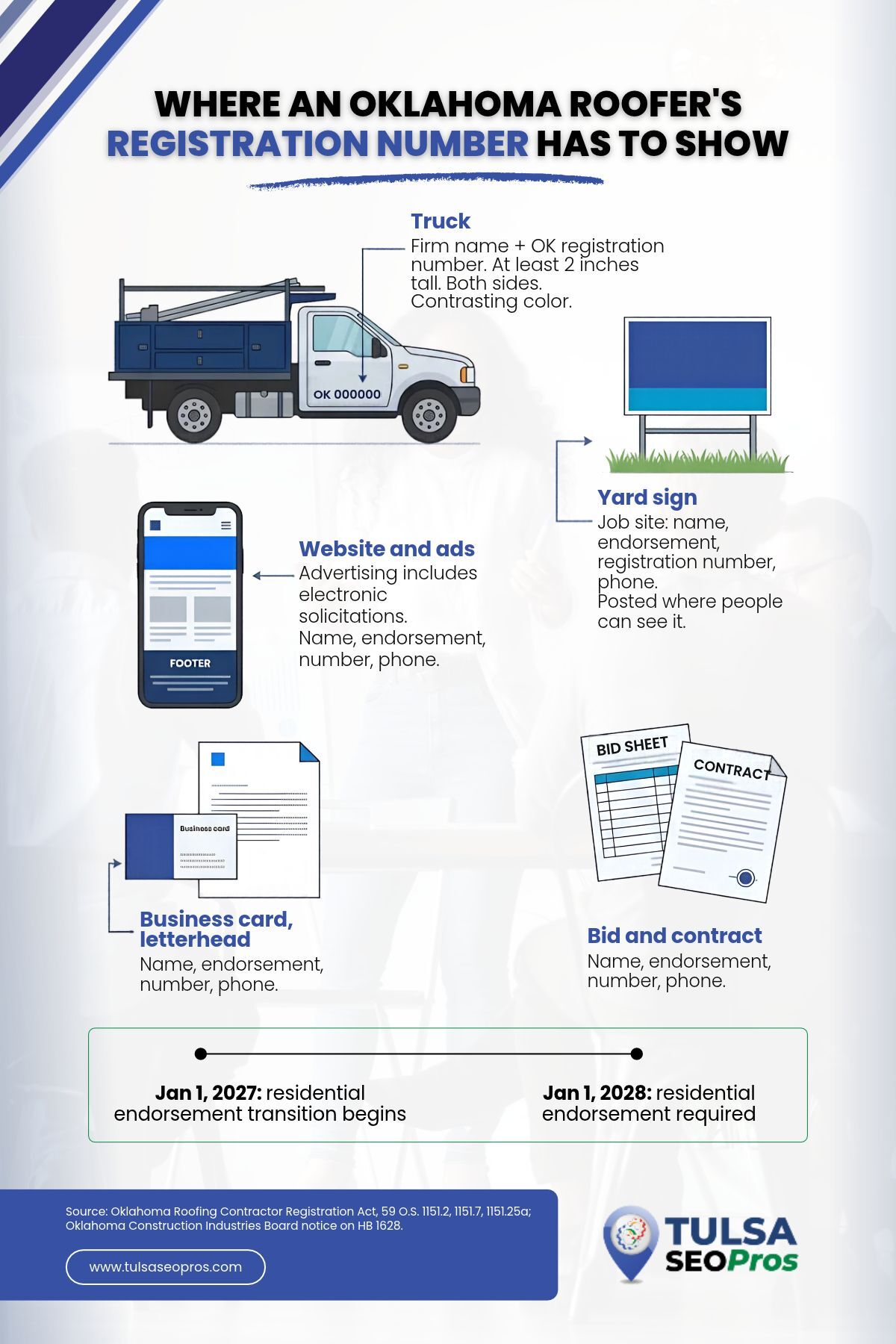
Oklahoma’s Roofing Contractor Registration Act requires a registered roofer to show the firm name, the registration number, any endorsement, and the registration phone number on all media carrying the business name. That list includes vehicle signs, business cards, contracts, bids, letterhead, signs, and advertisements. The Act defines advertising to cover radio, television, and electronic solicitations, so websites, paid search ads, and social ads are in scope. Trucks need the number with an “OK” prefix in letters at least two inches tall on both sides.
House Bill 1628 adds a residential roofing endorsement: a transition runs from January 1, 2027, and from January 1, 2028, the endorsement is required to offer residential roofing work. Plumbing, electrical, and mechanical contractors carry a parallel rule under the Construction Industries Board. Fines and misdemeanor exposure apply.
What Counts as Advertising Under the Oklahoma Roofing Act?
Nearly everything that asks for a job. The Act defines “advertise” as any written publication, solicitation, contract, bid, promotional item, or circulation meant to get someone to hire the advertiser, and it names business cards, directory display ads, vehicle signage, radio, television, and electronic solicitations. If a page, post, or ad exists to bring in roofing work, we treat it as advertising.
That definition sits in Section 1151.2 of the Roofing Contractor Registration Act published by the Oklahoma Construction Industries Board, and it matters more than any other line in the Act for marketing. Most roofers picture advertising as a billboard or a radio spot. The statute pictures it as anything that tries to win the job, directly or indirectly.
“Electronic solicitations” is the phrase that pulls in modern marketing. A website with a free inspection form solicits work. A Google search ad solicits work. So does a boosted Facebook post showing last week’s tear-off in Jenks with a “call us” button.
The same document also defines who counts as a roofing contractor, and the net is wide. It includes subcontractors and nonresident contractors, plus anyone who “attempts to or advertises” or “holds himself or herself out” as able to do roofing work. You do not have to have swung a hammer on a job for the advertising itself to count.
What the definition leaves out
The Act excludes a few groups from registration: people doing demolition or debris cleanup, some property owners working on their own buildings, and a few others spelled out in the Act. A marketing plan does not change which group you are in. If you are registered, the display rules apply to everything you publish.
The Places Your Registration Number Has to Appear
Section 1151.7 lists the business limitations that come with a registration certificate, and two of them are about display. Paragraph 2 covers vehicles. Paragraph 4 covers the job site and “all media containing the registrant’s name,” which is the clause that reaches your marketing.
| Asset | What has to show | Where the rule sits |
|---|---|---|
| Work trucks and trailers hauling materials or tools | Firm name and registration number with “OK” before it, letters at least 2 inches tall, both sides, contrasting color | 59 O.S. 1151.7(2) and 1151.17(C) |
| Job site | Name, any endorsement, registration number, and the registration phone number, posted in a conspicuous place | 1151.7(4) and 1151.17(D) |
| Magnetic signs, business cards, letterhead | Name, endorsement, registration number, phone | 1151.7(4) |
| Contracts and bids | Same four items | 1151.7(4) |
| Signs and advertisements, including electronic | Same four items | 1151.7(4), read with the 1151.2 definition |
| Building permits | Registration number supplied to the permit office and written on the permit | 1151.7(5) and 1151.17(A) |
Section 1151.14 then lists grounds for a complaint against a roofer, and two of them are marketing failures stated plainly. One is failing to display the name, endorsement, and number on vehicles. The other is “advertising, either directly or through another, for roofing contractor work without a valid, continuing registration, or without displaying registration number on advertisement.”
Notice the words “through another.”
If a lead company, a door-knocking sales crew, or a marketing agency runs ads for you, those ads are still your ads under this section.
Trucks and trailers
The vehicle rule is the most specific display requirement in the Act, and it is the easiest one to lose in a wrap design. Designers love a clean truck with a giant logo and a phone number. The statute wants the firm name and the “OK” number in letters and numerals at least two inches high, on both sides, in a color that contrasts with the paint.
A two-inch minimum is easy to meet on a truck door. It is easy to lose, too, when a designer tucks the number into a taillight graphic or prints it in gray on silver. Check the proof against the statute before the wrap shop prints it.
Two inches, both sides, every truck that hauls tools.
Yard signs and the job site
Here is where compliance and marketing overlap, and for once the rule works in our favor.
The Act requires the name, endorsement, number, and phone to be posted in a conspicuous place on each job site. Plenty of roofers in Tulsa County already stake a yard sign in front of a re-roof, because neighbors read them.
Build that sign so it does both jobs. One well-designed sign carries the brand, the phone, the registration number, and the endorsement line, and it satisfies the posting rule while it advertises to the street. That beats a laminated sheet taped inside a truck window, which meets nothing and sells nothing.
What Changes on January 1, 2027?
Residential roofers start moving to a new endorsement, and their marketing has to move with it.
House Bill 1628 created a residential roofing endorsement, and the transition begins on January 1, 2027. Roofers registered and in good standing by that date can be grandfathered in, and from January 1, 2028, the endorsement is required to offer or perform residential roofing work in Oklahoma.
The Construction Industries Board’s notice on the new residential roofing endorsement spells out what grandfathering takes: 10 hours of approved continuing education or a passing score on the residential roofing test, then four hours of continuing education each year to renew. The bill itself, House Bill 1628 on the Oklahoma Legislature’s bill tracker, became law without the governor’s signature on May 28, 2025. A 2026 bill, SB 1873, then set the current January 2027 and January 2028 dates.
The marketing consequence is in that same Board notice. An endorsed registrant who contracts directly with a property owner or prime contractor must show the business name, the endorsement type (residential, commercial, or both), the registration number, and the phone number on all business materials. That list includes vehicles, business cards, contracts, bids, letterhead, signs, and advertisements.
So every asset that shows your number today will need the endorsement type added once you hold it. Here is the order we would work in:
- Get the grandfathering done early in 2027, so the endorsement exists before your spring storm season marketing goes out.
- Update the website footer and contact page first, because they are the cheapest assets to change and the most checked.
- Rebuild paid search and social ad copy next. Old ads keep running until someone edits them.
- Reprint yard signs, magnets, and business cards in one order, not three.
- Book the truck lettering update last, since it costs the most.
If you are starting a new roofing company
New applicants who are not registered and in good standing by January 1, 2027, get no grandfathering. Section 1151.25a says they may not “sell, offer, bid, inspect, or perform” any residential roofing work until the endorsement is issued. That means a new company should not launch residential ads, a lead form, or a door-hanger run before the endorsement arrives. Plan the launch date around the endorsement, not the other way around.
Your Website, Ads and Social Posts, Asset by Asset
The statute names categories, not platforms. Here is how we map those categories onto the marketing a roofing company in Broken Arrow or Bixby actually runs:
- Website footer. It prints on every page, so it covers the whole site at once. Firm name, “OK” registration number, endorsement type, and phone.
- Contact page and every quote or inspection form, including the confirmation email it sends.
- Every paid landing page. These are often built outside the main site template, so they miss the footer. Check each one.
- Search ads. Ad text is short, so we usually carry the number in an asset line or on the landing page and in the ad where space allows. The landing page is where most of the reading happens.
- Facebook and Instagram ads, and organic posts that ask for work. A post showing a finished job with a “book your inspection” line is soliciting.
- Estimate and proposal PDFs, since bids are named outright.
- Email signatures for anyone who sends estimates.
- Door hangers and mailers, which are written publications in the plainest sense.
A website rebuild is the right moment to bake this into the template instead of patching it page by page. Our WordPress web design builds put the registration block in the global footer and the quote-form template, so a new landing page cannot ship without it. The same thinking applies to ads: our pay-per-click campaigns for trades carry the license line into every landing page variant we test.
Social media is where it slips most.
Posts go out fast, often from a phone on the job, and nobody checks them against a statute. Put the number in the profile bio and in any pinned or boosted post, and keep a caption template with the line already in it. Our social media management runs from templates like that for exactly this reason.
Do Plumbers, Electricians and HVAC Contractors Have the Same Rule?
Yes, and for plumbers, electricians, and HVAC contractors the rule is written even more directly.
The Construction Industries Board’s rules for each licensed trade say the contractor’s state license number “must be displayed on all advertising, contracts, and bids.” Plumbing sits in OAC 158:30-5-3, electrical in 158:40-5-4, and mechanical (which covers HVAC) in 158:50-5-4.
Each of those rules carves out only two things: uniforms and promotional items such as pens, key chains, and tape measures. Websites and online ads are not on the exemption list. Each trade also carries a truck rule matching the roofing one, with the “OK” prefix and two-inch letters on both sides of every vehicle hauling tools and materials.
| Trade | License number on advertising | Vehicle lettering | Exempt from the ad rule |
|---|---|---|---|
| Roofing | Name, endorsement, number, and phone on all media | “OK” number, 2 inches, both sides | None listed for registrants |
| Plumbing | Contractor license number on all advertising, contracts, bids | “OK” number, 2 inches, both sides | Uniforms, promotional items |
| Electrical | Contractor license number on all advertising, contracts, bids | “OK” number, 2 inches, both sides | Uniforms, promotional items |
| Mechanical (HVAC) | Contractor license number on all advertising, contracts, bids | “OK” number, 2 inches, both sides | Uniforms, promotional items |
For the HVAC and plumbing companies we work with in Sand Springs and across Green Country, the fix is identical to the roofing one: footer, forms, landing pages, ad copy, trucks. The details for each trade live on our HVAC marketing and plumbing marketing pages.
What Does It Cost to Get This Wrong?
More than a reprint, although the reprint is usually the part owners notice first.
The Board’s published fine schedule under OAC Title 158, Chapter 10 prices a missing license number on advertising, contracts, and bids separately from contracting without a license at all. The Roofing Act adds its own penalties on top.
| Violation | Penalty | Source |
|---|---|---|
| Failure to display the state contractor license number on advertising, contracts, and bids | $70 first, $190 second or later | OAC 158:10-3-2 |
| Contracting without an active license or registration, including offering work through advertisement | $500 first, $1,000 second or later | OAC 158:10-3-1 |
| Any violation of the Roofing Act, prosecuted as a misdemeanor | Fine up to $500 per violation | 59 O.S. 1151.3(C) |
| A business entity advertising or acting as a roofer while not registered | Administrative penalty up to $5,000 | 59 O.S. 1151.3(B) |
| Residential endorsement violations | Up to $500, then $1,000, then $3,500, then revocation | 59 O.S. 1151.2a |
The small citation is not the real exposure.
A roofing complaint can be filed by “any person” under Section 1151.14, and a competitor who spots your unnumbered truck in Owasso is a person. Misdemeanor convictions can also cost you the registration itself.
A Visible Number Also Wins Jobs in Tulsa
Compliance is the floor.
The number is also a sales tool, and roofers who hide it are giving away a trust signal they already paid for.
The Construction Industries Board runs a public “Are They Licensed?” search that lets anyone look up a registered roofing contractor, and a separate search for electrical, mechanical, and plumbing licensees. Homeowners use it. After a hailstorm, when trucks from other states start knocking on doors around Tulsa, the roofer whose number is on the yard sign, the truck, and the website is the one a careful homeowner can check in a minute. The one without a number looks like the storm chaser, even when he is local.
We would put the number where the decision gets made. On the website, that is next to the phone number in the header on mobile, not buried at the bottom of a long page. On an estimate, it goes beside the signature. On a truck, it goes where the neighbor reads it from the sidewalk.
It also feeds lead quality, which is the part of this most roofers never think about.
A visible registration and endorsement answer the “are you legit” question before the call, so the conversation starts on price and scope instead of credentials. That is part of what we cover when we talk about roofing leads you own instead of rent.
Put Your Registration Number on Every Asset Before 2027
Pull every place your business name appears, run it against the table above, and fix what is missing before January 2027 marketing goes live. Start with the website footer, forms and landing pages, then ads, then print, then trucks. When the residential endorsement is issued, add the endorsement type to each of those in the same order.
If you want a second set of eyes on it, our roofing digital marketing agency work starts with exactly this kind of asset audit for roofers in Tulsa, Broken Arrow, and Owasso. Tulsa SEO Pros will go through your site, ads, and print with you and hand back a list of what to change, in the order that costs the least. This is our reading of the published statute and rules, not legal advice, and the Construction Industries Board answers compliance questions directly.