Content marketing for plumbers works when every page answers a question your customers actually ask, using a source a national blog cannot copy. In Tulsa, that source already exists. The City publishes a water quality report every year, posts its lead and copper test results, and runs a service line program that mails letters to homeowners. Read those documents next to your own call log and you have a year of topics, each with the evidence already attached.
TL;DR
Content marketing for plumbers in Tulsa can be planned from four documents: the City of Tulsa’s 2026 Water Quality Report (covering January 1 to December 31, 2025), the City’s 2026 Lead and Copper Compliance Monitoring Results, the City’s True Reads service line program page, and the plumbing company’s own call log. The 2026 report lists lead at a 90th percentile of 1.20 ppb against a 15 ppb action level, with 0 sites above it, and names “corrosion of household plumbing systems” as a likely source of both lead and copper. The report prints no hardness figure, so a plumber should not publish one borrowed from a national map. Publishing follows the documents: the federal rule says the report must reach customers by July 1 each year, and the lead results arrive after the summer sampling window. Google’s guidance warns against writing to a word count or publishing lots of pages in the hope some perform.
What Should a Plumber Actually Publish?
A plumber should publish pages that answer the questions customers ask before they call, built on facts the plumber can point to. That rules out most of what generic content plans suggest. A post titled “five signs of a leak” exists on thousands of sites already, and none of them knows anything about water in Tulsa.
The better test is simple. Could a plumbing company in another state publish this page word for word? If yes, it adds little. If the page needs Tulsa’s own numbers, Tulsa’s own programs or your own jobs to make sense, it is worth writing.
Here are the four documents we would start from:
| Document | Who publishes it | What it is good for |
|---|---|---|
| 2026 Water Quality Report | City of Tulsa | Lead, copper, disinfectant, source lakes, who to call |
| 2026 Lead and Copper Compliance Monitoring Results | City of Tulsa | The newest tap sample numbers, by sample site |
| True Reads service line program | City of Tulsa | Service line letters, pipe material, meter work |
| Your call log | You | The exact words customers use, by town |
Our older guide to marketing a plumbing company treats content as one item on a long list, next to ads and reviews. That list is a fine starting point (you can read it in our plumbing digital marketing guide for plumbing companies. What it does not say is where the topics come from. That is the gap this plan fills.
The 2026 Tulsa Report, Read as a Topic List
The water quality page the City of Tulsa publishes carries the 2026 report, a separate edition for Spavinaw, the latest lead and copper results, and a hardness explainer. The City says the report goes out in June of each year to every utility customer in Tulsa. So your Tulsa customers already have a copy, whether or not they read it.
None of the content marketing guides for plumbers we read while writing this one mention it. That is the opening.
What the 2026 report says about Tulsa’s water
The 2026 edition covers samples taken from January 1 to December 31, 2025. The City says its laboratory staff and plant operators analyzed more than 47,000 samples in 2025. Tulsa’s water comes from three lakes in northeastern Oklahoma: Lake Oologah, Lakes Spavinaw and Eucha, and Lake Hudson.
It also says which treatment plant usually serves which side of town. Residents in north and west Tulsa usually get water from the Mohawk plant, and those in the south and east usually get it from the A.B. Jewell plant. Water moves through more than 2,460 miles of underground lines to reach them.
The lead and copper lines are the plumbing lines
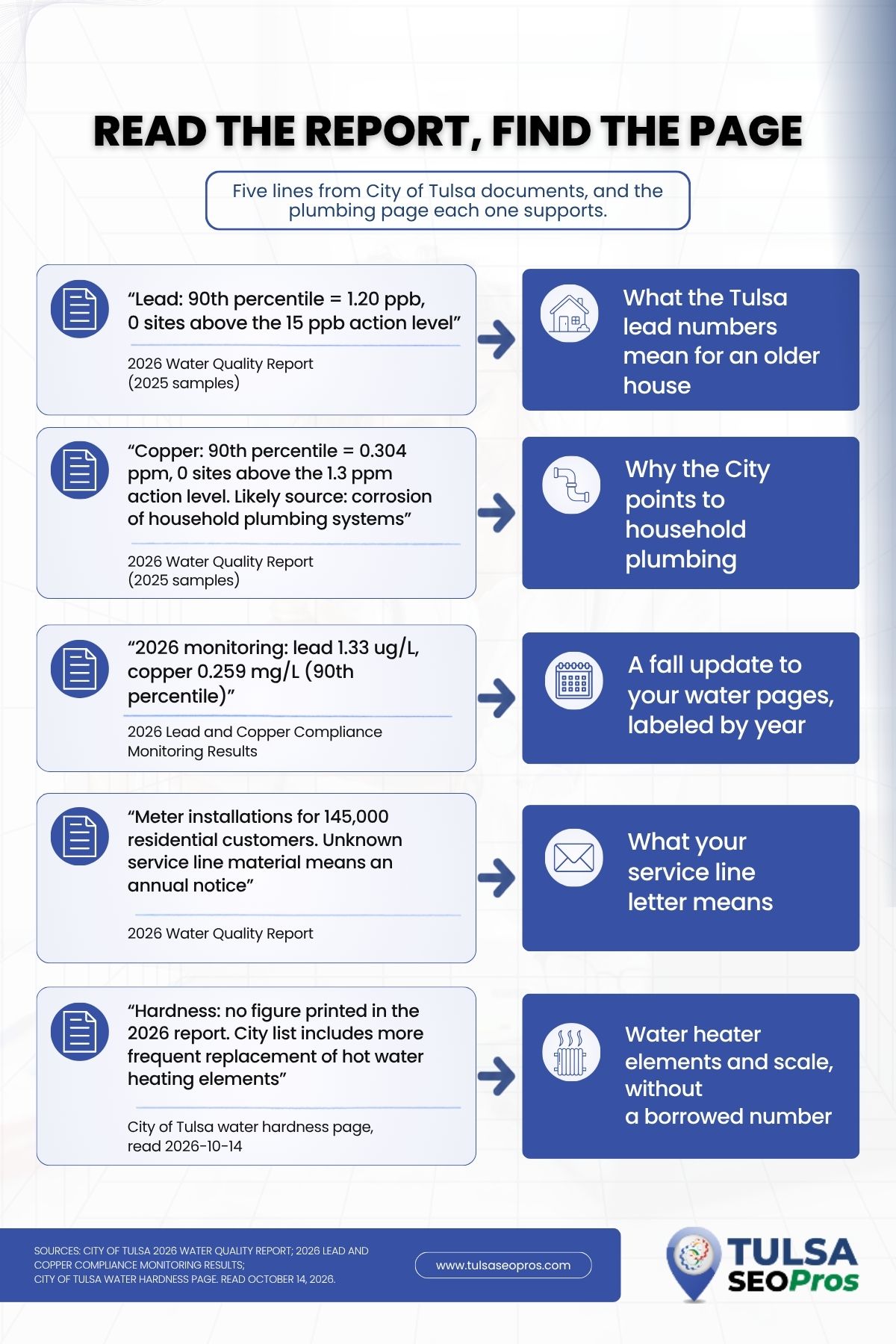
Two rows in the data table matter more to a plumber than the rest. For lead, the 2026 report gives a 90th percentile of 1.20 ppb, a range of 0 to 3.98, and 0 sites above the 15 ppb action level. For copper, it gives a 90th percentile of 0.304 ppm and 0 sites above the 1.3 ppm action level. Both rows list “corrosion of household plumbing systems” as a likely source.
Read that last phrase twice. The City’s own report says lead in drinking water “is primarily from materials and components associated with service lines and private plumbing,” and that the City “cannot control the variety of materials used in plumbing fixtures.” The utility is telling its customers that the part of the system past the meter belongs to someone else. That someone is often a plumber.
A page built on those lines could answer:
- What do the lead and copper numbers in the Tulsa report mean for an older house?
- Why does the City point to household plumbing, and what would a plumber check?
- Should I run the tap before drinking? (The report says 30 to 120 seconds when water has sat for several hours. Quote it; do not improvise it.)
The contact lines tell you what is not your job
The report also lists who handles what. Taste and color concerns or line breaks go to the City’s Water Distribution line, and water quality questions go to Water Quality Assurance. A short page that says “call the City for this, call us for that” earns trust because it sends some callers away. It also keeps you from booking a truck roll for a main break that the City fixes.
Why Does the Hardness Number Matter if the Report Leaves It Out?
It matters because the City’s own list of hard water effects reads like a plumber’s work order, and a hardness number is easy to copy wrong. The City’s hardness explainer gives a rating scale, from soft (less than 1.0 grains per gallon) to very hard (over 10.5). The 2026 Tulsa report itself prints no hardness figure. Neither does its data table.
That gap is useful. It tells you exactly what not to do: grab a hardness figure from a national map or a water softener brand and present it as Tulsa’s. If a customer reads a different number on the City’s site later, you look careless, and the page loses the trust it was written to earn.
The City’s own list of “hard water evidence in your home” is quotable, and it is plumbing work from end to end:
- Scale buildup on plumbing fixtures and kitchen appliances.
- Clogged pipes or appliances, with reduced water flow and more repairs.
- Higher water heating costs from scale, and “more frequent replacement of hot water heating elements.”
- Soap scum on tubs, tile, and basins.
The City also says plainly that “water hardness is not a safety issue.” Put that line on the page. It keeps a water heater article from sounding like a scare piece.
If you want a number on the page, call Water Quality Assurance, ask for the current figure, and cite the answer with the date you got it. If you cannot get one, write the page without a number. The scale table and the evidence list still make a useful page about water heater elements and fixture scale in Tulsa homes.
Service Line Letters Are a Page Waiting to Be Written
Homeowners in Tulsa are getting letters about their service lines, and most of them will search before they call anyone. The 2026 report explains why. The City is building its lead service line inventory through its True Reads program, contracting out meter installations for 145,000 residential customers and inspecting the service line during each meter change. If a service line’s material is unknown, the report says it “may be lead” and the customer “will receive an annual notice until the material can be identified.”
That annual notice is a search waiting to happen. A homeowner holding it wants to know what it means, whether it is urgent, and who can look at the pipe.
The True Reads page the City runs gives you the factual backbone. It describes how to tell lead, galvanized iron, copper, and plastic apart with a coin or key and a magnet. It also quotes the City water director saying the City does not have lead water mains, that records show copper and galvanized pipe were used for Tulsa service lines, and that crews have found a small number of lead connectors, typically in older parts of town where construction dates from the 1920s and 1930s.
At the federal level, the EPA’s Lead and Copper Rule Improvements page (last updated December 29, 2025) says the final rule requires drinking water systems “to identify and replace lead pipes within 10 years.” That is the reason the letters exist, and it is the most a plumbing page should say about federal law.
A good service line page:
- Quotes the City’s wording on what an unknown status means.
- Links to the City’s inventory map rather than describing it from memory.
- Shows the pipe identification steps in the City’s words, with your own photos of each pipe type.
- Says when a plumber is the right call and when the City is.
A bad one claims every older Tulsa house has lead pipes, quotes replacement deadlines nobody confirmed, or gives health advice. The City and EPA both run hotlines for that, and the report lists them.
Your Call Log Is the Source Nobody Else Has
Every document above is public. Your call log is not, and Google’s own guidance explains why it counts. Its page on creating helpful, people-first content asks whether a page shows first-hand knowledge, “for example” from “having actually used a product or service, or visiting a place.” A plumber has been in the crawl space. A content writer in another state has not.
Turning calls into topics takes a few weeks of plain record-keeping. Have whoever answers the phone write down five things for each call:
| Field | Why it matters for content |
|---|---|
| Town or neighborhood | Tells you whether the page is about Tulsa, Broken Arrow, Owasso, Jenks, or Bixby |
| The customer’s first sentence, word for word | That is the search phrase, in the customer’s own words |
| What you found on site | The real answer, which becomes the body of the page |
| Age of the house or fixture, if known | Ties the page to the housing stock you actually see |
| Whether a photo was taken | A real photo beats stock every time |
After a month, sort the log by the customer’s first sentence. Questions that repeat are topics. Questions that come with a town attached are local pages. Questions that need a City document to answer are the ones from the sections above.
The same calls also shape your Business Profile, which is a separate job from the blog. Our piece on how Tulsa plumbers climb in Google Maps covers that side. Use the call log for both, but do not paste the same copy into each.
How Often Should a Plumber Publish?
Publish when a source changes or a question repeats, not on a weekly quota. Google’s helpful content page lists “producing lots of content on many different topics in hopes that some of it might perform well” as a warning sign. It also lists writing to a word count, and answers its own question: “(No, we don’t.).” A plumbing company that publishes two strong local pages a quarter gives readers more than one that posts filler every Monday.
The Tulsa documents come with their own calendar:
| When | What changes | What to update |
|---|---|---|
| June | The City sends the new water quality report to customers | Refresh the lead, copper and source lines on your water pages |
| By July 1 | The federal deadline for that report, per EPA | Check the report is posted before you quote it |
| After the summer sampling window | The City posts new lead and copper results | Add the newest 90th percentile figures, with the year |
| Whenever letters go out | Annual service line notices | Make sure your service line page still matches the City’s wording |
The federal deadline comes from the EPA’s Consumer Confidence Report information for consumers, which says reports “must be sent by your water supplier each year by July 1.”
The lead and copper results show why the second half of the year matters too. The City’s 2026 monitoring results, from tap samples taken in July and August 2026, give a 90th percentile of 1.33 ug/L for lead and 0.259 mg/L for copper. Those are newer than the figures in the 2026 report, which reflect 2025 samples. A page that carries both, each labeled with its year, is more accurate than any page that carries one number with no date.
Broken Arrow, Owasso, Jenks and Bixby Need Their Own Source
Tulsa’s report covers the City of Tulsa’s water. It does not tell you what comes out of a tap in another city’s system, and you should not assume it does. If your trucks run to Broken Arrow, Owasso, Jenks or Bixby, find the report for the system that serves each address before you write a word about that town’s water. EPA’s consumer page links to a lookup tool for exactly this.
This is also where the rule about unique town pages earns its keep. A Broken Arrow page that repeats the Tulsa numbers with the town name swapped is a cloned page, and it is wrong on the facts. The way we approach content for local audiences starts from that same rule: each town gets its own source, or it does not get its own page.
Measuring Whether a Page Earned Its Place
A page earns its place when it brings calls you can trace back to it. Pageviews alone do not tell you that. Track the phone number and form on each page, and compare call volume against the questions in your log.
We wrote about the lead numbers a trades owner should see every month, and the same report works for plumbing pages. Search Console adds the other half: the actual queries a page shows up for. If a water heater page starts appearing for hard water questions, that is the next page to write. Our explainer on how plumbing marketing turns searches into calls walks through how those pieces connect.
No page comes with a promise. Some will pull calls for years, some will not, and the call log is how you tell them apart.
Pull Up the 2026 Tulsa Report and Write Your First Page
Start with one document and one page. Open the 2026 report, read the lead and copper rows and the contact lines, and write a page that answers what a Tulsa homeowner would ask after reading them. Quote the City’s numbers with the year, add your own photos, and link to the source. Then start the call log, so the next topic comes from your customers instead of a list.
If you would rather plan this with help, our plumbing digital marketing agency team works on SEO and paid search for plumbing companies. You can also reach Tulsa SEO Pros directly to talk through which page to write first.